Disclaimer: This blog post is intended solely for educational and informational purposes. It is not legal advice, nor is it intended to influence political positions or actions. I deeply respect the institutions of the United States and the solemnity of their processes. Nothing in this post should be interpreted as criticism, protest, or political messaging. My only purpose is to help clarify complex legal topics for those seeking to understand them.-Lissie
On May 19, 2025, the United States Supreme Court issued a decision that directly affects hundreds of Venezuelans in the U.S. It allowed the current administration to move forward — for now — with the early termination of Temporary Protected Status (TPS) that had been granted to our community in 2023.
That headline caused uncertainty, fear, and a flood of questions. But it also gave us a chance to educate ourselves.
Today, I want to walk you through this process clearly and without legal jargon — to explain how our legal system works, what each court did in this case, what this order really means, and what comes next. Because understanding the law is also a form of empowerment.
What Is TPS?
Temporary Protected Status (TPS) is a humanitarian protection that allows nationals of certain countries experiencing crisis to remain in the U.S. legally. It protects against deportation and provides work authorization, but it does not provide a path to permanent residency or citizenship.
In 2021, the U.S. government designated Venezuela for TPS due to the country’s humanitarian crisis. In 2023, that protection was extended and redesignated through October 2026.
What Happened in 2025?
In January 2025, with the return of a new administration, DHS Secretary Kristi Noem announced that she would terminate TPS early, citing national security concerns and alleged gang infiltration (referencing the Tren de Aragua).
In response, the National TPS Alliance and some individual Venezuelan TPS holders filed a lawsuit in federal court, arguing that the decision was discriminatory, racially motivated, and legally unfounded.
What Did the Federal Judge Do?
The case was assigned to Judge Edward Chen, in the U.S. District Court for the Northern District of California.
✔️ Judge Chen granted a preliminary injunction — a court order that temporarily blocked the termination of TPS while the case moved forward.
Why?
He found that the termination would cause irreparable harm to TPS beneficiaries. He saw legal merit in the plaintiffs’ arguments. He ruled that the public interest weighed in favor of protecting immigrant families.
What Did the Government Do?
The government appealed Judge Chen’s order to the Ninth Circuit Court of Appeals — and that appeal is still pending.
Meanwhile, it also filed an application to stay (a request for temporary suspension) with the Supreme Court of the United States.
Why Was Justice Kagan Involved?
Justice Elena Kagan is one of the nine Justices of the Supreme Court. Each Justice is assigned to oversee a judicial circuit in the country.
Kagan is the “Circuit Justice” for the Ninth Circuit, which includes California.
So when the government needed emergency relief (the “application to stay”), it had to submit it first to Justice Kagan. She chose to refer the matter to the full Supreme Court, which is common in high-impact cases.
What Did the Supreme Court Decide on May 19?
The Court granted the stay requested by the government.
This means that, for now, the government can proceed with terminating TPS while the case continues in the appeals court.
Importantly, this is not a final decision. The Supreme Court did not rule on whether the termination of TPS is legal. It simply allowed it to move forward temporarily during the legal process.
What’s the Legal Path Ahead?
Here’s how the process works, step by step:
1️⃣ District Court (Judge Chen): → Heard the case and granted a preliminary injunction to protect TPS holders.
2️⃣ Ninth Circuit Court of Appeals: → The government appealed. A ruling is pending.
3️⃣ Supreme Court: → The government asked for a stay to temporarily block Judge Chen’s order. → The Court granted the stay on May 19.
4️⃣ What’s next? → We now await the Ninth Circuit’s decision. → After that, the losing party may ask the Supreme Court to hear the case (via certiorari).
What Is a Preliminary Injunction?
A preliminary injunction is a court order that temporarily blocks an action to protect someone from harm while a case is being decided.
In this case, Judge Chen used it to temporarily block the cancellation of TPS, finding that the harm to TPS holders would be too great if it were allowed to proceed immediately.
What Is an “Application to Stay”?
An application to stay is a request to a higher court (like the Supreme Court) asking it to pause or suspend a lower court’s decision while an appeal is being decided.
In this case, the government asked to suspend Judge Chen’s order — and the Court said yes. This doesn’t mean the case is over. It just means the government can act while the case continues.
What Does This Mean for Venezuelans with TPS?
🔴 The administration can now move forward with terminating TPS for Venezuelans redesignated in 2023.
🟡 Work permits (EADs) issued with expiration dates through October 2026 are not automatically invalid, but their legal foundation is now under threat.
🟢 The case is still active — and the final decision could still go either way.
TPS 2023 Designation (newest group):
❌ The Supreme Court decision allows the Trump administration to cancel this protection.
⚠️ TPS holders under this group may now lose their legal status and work permits at any moment unless further legal action blocks the termination.
TPS 2021 Designation (original group):
✅ This protection remains valid for now.
If you were granted TPS in 2021 and re-registered in time, your protection continues unless the administration moves to terminate this designation separately.
Why It’s Important to Understand All This
Because headlines don’t tell the full story — and what happens in courtrooms can change lives.
By understanding the process, we protect ourselves.
This blog does not replace legal advice, but it can help you understand your legal reality and your rights.
A Reminder for Our Entire Community: TPS Is Temporary
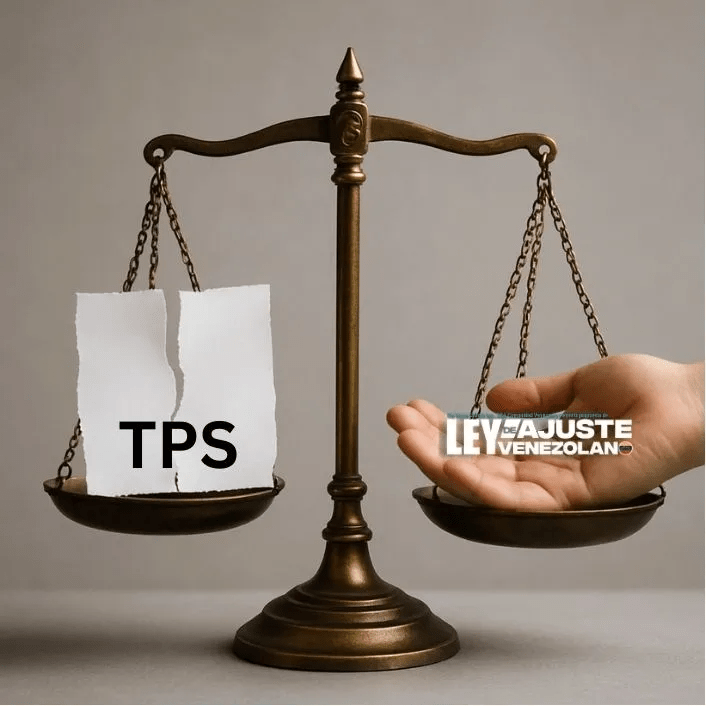
Situations like this remind us of a hard truth: TPS is not stability. It’s a temporary policy, vulnerable to politics, subject to cancellation, and never intended to be permanent.
That’s why now, more than ever, we must turn our energy toward a long-term solution: the Venezuelan Adjustment Act (VAA).
Why Supporting the VAA Matters — Even Beyond TPS
Supporting the VAA doesn’t mean turning our backs on TPS — it means acknowledging that TPS was never meant to be enough.
TPS lets us survive, but not thrive. It gives us space, but not roots. The VAA offers something TPS never could: a path to permanent residency, legal certainty, and a future without fear.
This bill was created by and for Venezuelans, not by lobbyists, but by community members and advocates — including the leadership of Mildred Rodríguez, CEO of My Voice Counts Charities Foundation, Inc., and an extraordinary team of volunteers from across the Venezuelan diaspora.
While the bill includes a cutoff date for legislative reasons, its spirit is inclusive and forward-looking. Supporting it is an act of solidarity, vision, and justice.
Even if it doesn’t help you directly, it might help your sister, your best friend, your coworker, or the neighbor who watched your kids when you had to work a double shift.
Support the VAA not just for what it is — but for what it unlocks.
Conclusion
The legal battle over TPS for Venezuelans is not over. The Supreme Court’s May 19 decision was just one procedural step in a much broader and ongoing legal fight.
But this moment also reminds us of a deeper truth: TPS is temporary — and stability cannot depend on political winds.
That’s why, beyond staying informed and engaged in the courts, we must also push for permanent solutions like the Venezuelan Adjustment Act (VAA) — a bill that wasn’t born in Washington lobbying firms, but in our own community.
The VAA offers something TPS never could: a path to permanent residency, legal dignity, and the chance to truly belong.
💡 If you have TPS, stay informed. 💬 If you don’t, but someone you love does, share this information. 🤝 And if you’re an ally of our community — your voice in Congress matters more than ever.
📢 The fight for human rights is also fought through education, advocacy, and collective action.
💛💙❤️ — Lissie
 The LAW Way
Leave a comment