As a law student and Project Assistant (Volunteer) with My Voice Counts Charities Foundation, Inc. (MVC), I’ve spent the past year fully committed to one goal: helping advance the Venezuelan Adjustment Act (VAA) forward in Congress.
I’ve walked the halls of Congress delivering data, spoken face-to-face with lawmakers and their staff, and poured countless hours into understanding every legal and human angle of this bill. Recently, I also did a deep dive into a major federal court case — National TPS Alliance v. Noem — where powerful expert testimony confirms exactly what we’ve been saying all along: Venezuelans are contributing, law-abiding, and deserve a real path to stability.
Over the past few months, I’ve received a lot of questions from people in our community — and beyond — asking what this bill really does, who it affects, and why it matters. That’s why I put together this post.
First, I’ll answer some of the most common questions about the VAA in a simple Q&A format. Then, I’ll break down key findings from the federal case and show how they support this bill.
Q: What is the Venezuelan Adjustment Act?
A: The Venezuelan Adjustment Act is a bill introduced in Congress that would allow eligible Venezuelans who were physically present in the U.S. on or before December 31, 2021, to apply for lawful permanent residency. This bill is modeled after the Cuban Adjustment Act, which provided a path to residency for Cubans fleeing dictatorship. However, the VAA includes stricter eligibility criteria, including the cutoff date and mandatory background checks. Individuals with felony convictions or multiple misdemeanors are not eligible.
This is not an amnesty or a handout — it’s a structured legal framework for those who have already built lives in the U.S., are working, paying taxes, and contributing to their communities. It also does not include access to public benefits like food stamps or Medicare. This bill simply offers an opportunity to stay legally and continue contributing openly and fully to society.
Q: Why Venezuela and not other countries like Haiti, El Salvador, or Mexico?
A: This isn’t about picking one country over another. The VAA follows a specific legal precedent — the Cuban Adjustment Act — which was enacted because of Cuba’s dictatorship, human rights violations, and forced mass migration. Today, Venezuela is experiencing the same conditions: a repressive authoritarian regime, widespread persecution, economic collapse, and the largest displacement crisis in the Western Hemisphere.
The reason this bill focuses on Venezuelans is that their situation mirrors that of the Cuban population when the original act was passed. But this doesn’t mean other nations shouldn’t receive relief too.
Q: How can people support this cause?
A: You don’t have to be Venezuelan, or even an immigrant, to support this effort. Here are three ways anyone can take action:
- Sign the Petition: Visit the Ley de Ajuste Venezolano website: and add your name. Anyone 18 or older living in the U.S. — regardless of immigration status — can sign.
- Send a Letter to Your Representative: Use the “Work Table” feature on the VAA website. Just enter your address, and our system will help you send a personalized letter to your elected official with just a few clicks.
- Join the Movement: You can follow, share, and amplify our message. Or if you want to take it a step further, reach out and join one of our advocacy efforts directly. I’ve had the honor of going to Congress myself with the bill’s promoters and delivering updated reports on how Venezuelan professionals are already contributing to the U.S. economy — and how they could do even more with permanent status.
Every voice counts.
Q: Who can sign the petition?
A: Anyone 18 or older who lives in the United States can sign — regardless of citizenship or immigration status. This includes allies, employers, coworkers, friends, and neighbors who believe in fairness and justice. The broader our coalition, the stronger our message. These signatures help us demonstrate wide public support for the VAA when we present it to lawmakers.
Q: If we collect 500,000 signatures, does that mean the bill is automatically approved?
A: No, but these signatures are incredibly important. While they don’t guarantee passage, they give us real numbers to show to Congress. When lawmakers see that thousands of their constituents support this bill, it influences their priorities. Signatures help humanize the policy — they show that behind every number, there’s a person and a story.
Q: Some say the VAA is unfair because it only includes Venezuelans who were in the U.S. before December 31, 2021. What do you say to that?
When the VAA was first introduced in Congress in 2022, its advocates had to establish a reasonable eligibility period. The cutoff date of December 31, 2021, was chosen because it was the most recent full year before the bill was drafted. Now that the bill has been reintroduced, they’ve kept the same structure and date to maintain consistency and strengthen its chances of passing.
This is not about excluding people—it’s about making the bill feasible in Congress. Immigration bills like this often require a defined group to gain bipartisan support. A bill without a cutoff date would face significantly more opposition and could be much harder to pass.
That being said, this bill is a first step. That’s why it’s so important to push for its approval—every step forward in immigration policy matters, and this could be the key to unlocking more protections in the future.
WHAT THE EVIDENCE TELLS US
As part of my work with MVC, I reviewed the federal court filings in National TPS Alliance v. Noem, a case pending in the Northern District of California. In this case, Venezuelan TPS holders and the National TPS Alliance asked the court to postpone the implementation of a policy that would end Temporary Protected Status (TPS) for Venezuelans.
To support their motion, the plaintiffs submitted expert declarations from economists, historians, immigration attorneys, and public safety analysts — to demonstrate that Venezuelan TPS holders are deeply woven into the fabric of American society and that ending these protections would have serious consequences.
Here are some of the key takeaways from those declarations and how I see them connecting to the broader case for the VAA:
- David Card, Ph.D. (Nobel Laureate Economist): analyzed U.S. Census and labor market data and found that removing TPS protections for Venezuelans could reduce the U.S. GDP by $3.5 billion each year. He also projected a loss of over $434 million annually in Social Security contributions. What’s more, over 96% of income among Venezuelan TPS holders comes from employment—not public aid. In short, this is a group of workers who are educated, self-reliant, and vital to economic stability. The VAA offers a way to retain that stability.
- Elliott Young, Ph.D. (Historian and Migration Scholar): analyzed how Venezuelan migrants have been stigmatized through political rhetoric, often echoing historical patterns of racialized exclusion in U.S. immigration policy. He cited data showing that nearly half of Venezuelan immigrants hold college degrees — higher than both the U.S.-born population and other immigrant groups — and that 75% are active in the labor force. His work highlights how damaging mischaracterizations can become policy drivers. To me, that’s exactly why a structured, fact-based solution like the VAA is needed.
- Melanie Morten, Ph.D. (Stanford Economist): estimated that deporting 350,000 Venezuelan TPS holders would cost U.S. taxpayers $4.8 billion, and replacing them in the workforce would cost employers another $1.3 billion. Her declaration made it clear that removing TPS wouldn’t just hurt families — it would hurt the economy. That’s why I believe the VAA is a practical solution to avoid unnecessary economic harm.
- Watson & Veuger (Brookings Institution & AEI): offered a bipartisan analysis confirming that Venezuelan TPS holders are highly educated, economically productive, and not a public safety concern. They warned that revoking TPS would destabilize families, increase pressure on local governments, and stall growth. While they weren’t speaking about the VAA, their findings point to the need for a long-term legal option that matches the contributions of this population — and that’s exactly what the VAA would provide.
- Santiago Pérez, Ph.D.: emphasized that Venezuelan immigrants have consistently lower incarceration rates than U.S.-born citizens. His analysis also found that children of South American immigrants, including Venezuelans, tend to achieve upward mobility and long-term integration. In my view, his work supports the idea that this population represents a long-term investment in American communities — something the VAA would help safeguard.
- Steven Dudley (InSight Crime): focused on public safety claims and found no organized presence of the Venezuelan gang Tren de Aragua in the U.S. He reviewed public court records and interviewed law enforcement, concluding that only five federal cases even mention the group — none showing coordinated activity. This expert analysis reminds us why immigration policy should be driven by facts. I see the VAA as a way to move policy in exactly that direction.
- Stacy Tolchin (Immigration Attorney): explained that TPS provides legal protections — such as protection from deportation, detention, and job loss — that aren’t guaranteed through other avenues like asylum or parole. She noted that Venezuelan TPS holders would lose status entirely if the program ends, with few or no options left. This highlights the legal gap the VAA is designed to fill — offering a real, structured pathway for people who are already living and working here lawfully.
- Emilou MacLean (ACLU): documented how misleading public narratives have portrayed Venezuelan migrants as dangerous or criminal — despite the lack of evidence. Her declaration showed how these narratives can lead to harmful, reactionary policies. That’s why I believe it’s so important to back the VAA, which is based on data. The VAA offers a principled, evidence-based solution that ensures legal stability for those who have lawfully contributed to American society.
WHAT THE JUDGE SAID
The court agreed with much of what the plaintiffs presented. In a detailed decision issued on March 31, 2025, the judge granted the motion to postpone the termination of TPS for Venezuelans.
This ruling reinforces what Venezuelan advocates and experts have consistently argued — that ending TPS without a permanent solution would cause irreparable harm.
CONCLUSION: WHY THIS MATTERS
The VAA gives Congress a timely, practical, and structured solution to address the real-world needs of eligible Venezuelan individuals who have already become part of American communities.
As this issue continues to evolve, we hope that policymakers will consider the facts presented — including expert testimony, community needs, and legal context — in evaluating the best path forward. We remain committed to contributing constructively to that conversation.
If this issue matters to you, here are three ways you can get involved through the Ley de Ajuste Venezolano website:
- Sign the petition to express your support for a legislative solution that recognizes the contributions of Venezuelan nationals in the U.S.
- Send a letter to your members of Congress through the site — it’s quick, accessible, and helps ensure community voices are heard.
- Share this blog to inform others and help raise awareness about this ongoing effort.
Every action — no matter how small — helps contribute to thoughtful conversations and encourages solutions informed by the lived experiences of thousands of individuals.
*******
SOURCES
Court Filings – National TPS Alliance v. Noem
U.S. District Court for the Northern District of California Case No. 3:25-cv-01766-EMC
- Plaintiffs’ Motion for Preliminary Injunction (Filed February 20, 2025) – Request to postpone the implementation of the policy affecting Venezuelan TPS holders.
- Order Granting Motion to Postpone (Issued March 31, 2025) – The Court analyzed potential irreparable harm, statutory authority, procedural concerns, and supporting expert declarations.
Expert Declarations Submitted in Support of Plaintiffs’ Motion
- Dr. David Card, Nobel Laureate in Economics
- Dr. Melanie Morten, Economist, Stanford University
- Dr. Santiago Pérez, Economist
- Dr. Elliott Young, Historian, Lewis & Clark College
- Watson & Veuger, Researchers at Brookings Institution & American Enterprise Institute
- Steven Dudley, Co-founder, InSight Crime
- Stacy Tolchin & Emilou MacLean, Immigration Attorneys
Additional References
- Venezuela Travel Advisory, U.S. Department of State Reissued September 2024 – “Level 4: Do Not Travel” advisory due to conditions such as wrongful detentions, civil unrest, and poor infrastructure.
- Ley de Ajuste Venezolano Website
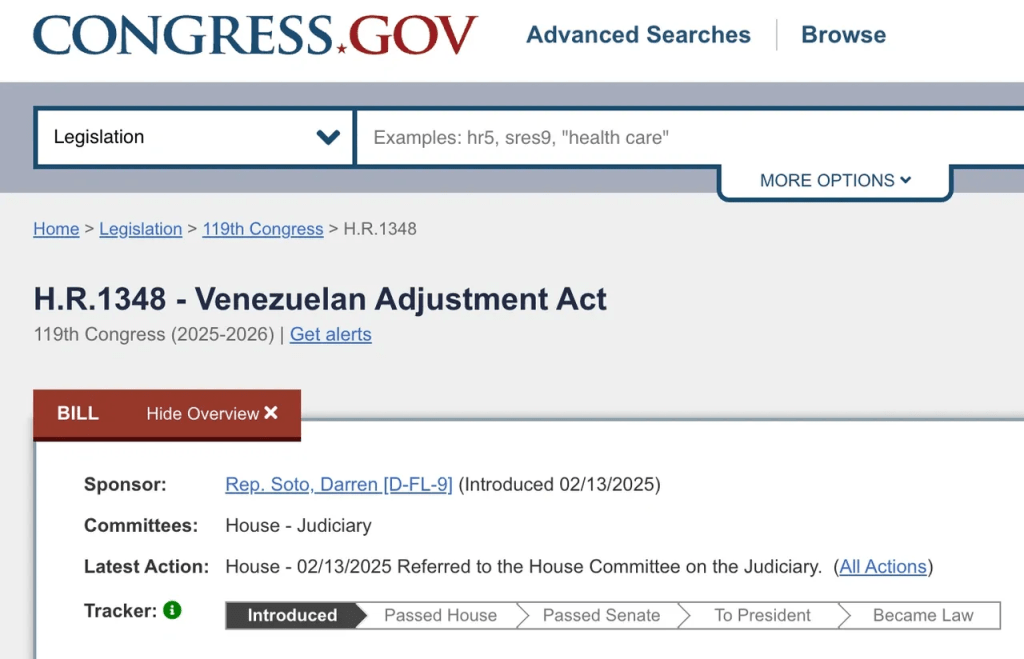
- H.R.1348 – Venezuelan Adjustment Act
 The LAW Way
Leave a comment