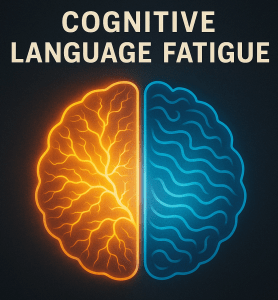
If you’ve ever taken the MPRE or sat down to study for the Bar and suddenly felt your brain shut down, you’re not alone. It happened to me recently. I thought I was sleepy. I thought I was losing focus. But what actually happened has a name: cognitive language fatigue.
Once I understood what it was, everything about how I study changed.
This post is for every bilingual law student, every immigrant bar taker, every one of us who reads, writes, thinks, and dreams in more than one language. You’re not “slow,” you’re not “tired,” and you’re definitely not incapable.
Your brain is simply doing double the work — literally.
Let’s break this down.
What Is Cognitive Language Fatigue?
Cognitive language fatigue is a real neurological response that occurs when your brain has been processing information in a language that is not your mother tongue for an extended period of time. It is mental exhaustion caused by sustained cognitive effort, which leads to reduced attention, slower processing, and difficulty recalling information [1].
Researchers describe it as the moment when the brain’s working-memory system becomes overloaded and begins to shut down non-essential processing. This is why you can feel wide awake and still suddenly hit a wall — your brain is protecting itself from overload.
A 2025 peer-reviewed study in International Review of Applied Linguistics found that even advanced second-language (L2) learners show clear signs of cognitive fatigue when performing demanding linguistic tasks, especially when the material is abstract or complex [1]. Legal English fits that description perfectly.
Why Does It Happen — Especially During Legal Exams?
Because legal English is not normal English.
Legal text is dense, abstract, packed with exceptions, layered conditions, and high-level reasoning. When bilingual readers engage with it, the brain must:
- Decode the language
- Interpret legal concepts
- Apply analytical reasoning
- Retain hypotheticals
- Compare exceptions
- Predict outcomes
- Make time-pressured decisions
Add to that the fact that bilingual individuals activate both languages at once when processing information — a well-documented phenomenon that increases cognitive load and attention demands [2].
This means your brain is doing twice the work of a native speaker. And as multiple studies confirm, even highly proficient bilinguals experience increased cognitive effort and faster mental fatigue when using their less dominant language [3].
Nothing is wrong with you. This is simply what bilingual legal reasoning feels like.
How Does Cognitive Language Fatigue Show Up?
You may recognize some of these moments:
- Words suddenly stop making sense
- You read a sentence three times and still can’t grasp it
- You feel “sleepy” but you’re not tired
- Your eyes move, but your comprehension shuts down
- You start second-guessing rules you know
- You become frustrated because “this doesn’t happen to me in Spanish”
That moment is cognitive fatigue. It’s predictable — and manageable.
How to Overcome It (Especially for Bar Prep)
The good news: cognitive language fatigue can be trained, just like endurance training for a marathon.
1. Build Language Endurance Gradually
Don’t start with 3-hour sessions. Begin with:
- 25–40 minutes of focused reading
- 5–10 minutes of rest
- Repeat
Your brain builds stamina over time.
2. Switch Languages to Reset Your Brain
A quick dose of your native language can reset your linguistic circuits:
- Listen to a 2-minute Spanish audio
- Read a short paragraph in Spanish
- Talk to yourself briefly in Spanish
Research shows this type of linguistic “reset” restores cognitive control.
3. Do the Hardest Reading in the Morning
Your language-processing center is freshest early.
Save practice questions for later.
4. Reduce Cognitive Load
Make legal English lighter on your brain:
- Highlight the rule first
- Chunk long sentences
- Underline connectors (“unless,” “however,” “only if”)
- Read the call of the question first
- Don’t translate — conceptualize
This reduces the burden on working memory.
5. Fuel Your Brain
Studies confirm L2 processing consumes more attentional and metabolic resources.
A quick snack or hydration can restore comprehension.
6. Sleep
Memory consolidation and bilingual processing recovery occur during sleep.
All-nighters hit bilinguals harder.
Stop Blaming Yourself
When I realized that what happened to me during the MPRE wasn’t laziness or lack of focus — but a neurological process supported by real research — everything changed.
Bar prep is already demanding. Doing it in a second language adds a layer of complexity that few people recognize.
But this is also your superpower.
You think in two languages.
You analyze in two worlds.
You survived immigration, adaptation, and transformation — and now you are preparing to become an attorney in a language that wasn’t even yours growing up.
That is power.
The moment you understand how your bilingual brain works, you stop fighting it and start working with it.
To Every Bilingual Bar Taker Reading This
You are not behind.
You are not slow.
Your brain simply works at an extraordinary capacity — and sometimes it overheats.
But you can train it.
You can strengthen it.
And you will pass.
Not despite being bilingual — but because of it.
Your brain is powerful. Your story even more.
And trust me: you’re going to walk into that exam room carrying both.
Sources Cited
[1] Camilleri, Joeline. “Investigating Cognitive Fatigue and Recall Accuracy Across Different Second-Language (L2) Idiom Learning Tasks.” IRAL – International Review of Applied Linguistics (2025).
[2] Kroll, Judith & Bialystok, Ellen. “Understanding the Consequences of Bilingualism for Language Processing and Cognition.” Journal of Cognitive Psychology (2013).
[3] Ershaid, Hadeel et al. “Highly Proficient Bilinguals Compensate Language Dominance Effects with Differential Attentional Resource Allocation.” Bilingualism: Language and Cognition (2025).


Leave a reply to The Bar Prep Ecosystem: What No One Tells You About Preparing for the Bar Exam – The LAW Way Cancel reply