Analysis | @thelaw.way
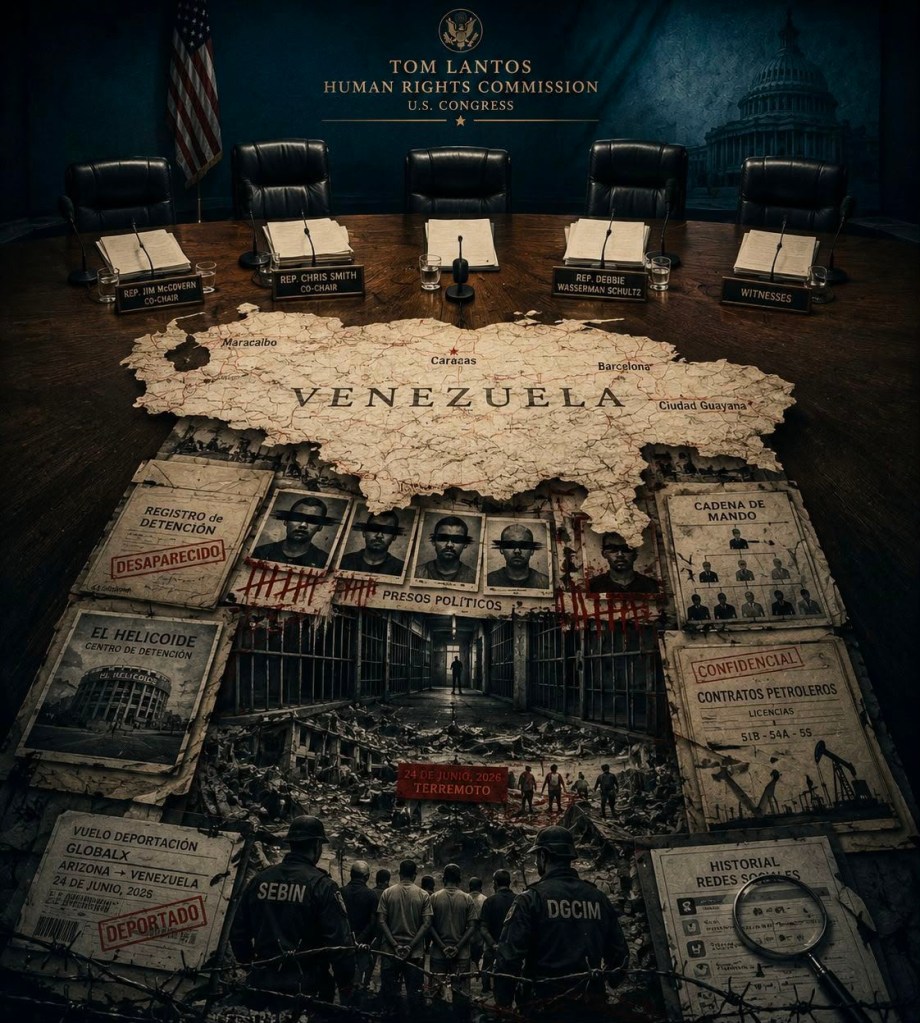
On July 16, 2026, the Tom Lantos Human Rights Commission of the U.S. Congress held a hearing on the human rights situation in Venezuela. It landed at a specific moment: six months after U.S. forces captured Nicolás Maduro and brought him to the United States to face charges, and three weeks after a devastating earthquake struck a country already living through what witnesses repeatedly called a “complex humanitarian emergency.”
Five witnesses testified before co-chairs Rep. Jim McGovern and Rep. Chris Smith, joined later by Rep. Debbie Wasserman Schultz: Martha Tinoco Rodríguez, founder of Justicia, Encuentro y Perdón (JEP), testifying from Caracas; Beatriz Borges, executive director of the Justice and Peace Center; Laura Cristina Dib, Venezuela program director at the Washington Office on Latin America (WOLA); Isabel Carlota Roby, senior staff attorney for Latin America at the Robert F. Kennedy Human Rights Center; and Andrés Martínez Fernández, senior policy analyst for Latin America at the Heritage Foundation.
This is a full account of what was discussed, not just the headline points, but the detail underneath them: the numbers, the individual cases, the policy disputes, and the places where witnesses genuinely disagreed.
The framing tension, from the opening statements
The hearing opened with two visibly different lenses on the same six months.
Rep. McGovern’s opening statement was pointed. He called for a roadmap toward democratic transition with real benchmarks: dismantling the security state, an independent judiciary, electoral reform, an end to restrictions on civil society, press freedom, and transitional justice. He questioned directly whether U.S. leverage in Venezuela is being used to improve the lives of Venezuelans or to enrich oil executives, foreign financiers, and officials on both sides. He asked whether the same American politicians who denounced Maduro’s illegitimacy would hold the current government to the same standard, or stay quiet while the administration cuts deals with what he characterized as the same regime under a different name.
Rep. Smith’s opening statement struck a more optimistic note about the trajectory since January, while still cataloguing the scale of the underlying crisis: the UN High Commissioner for Human Rights documented nearly 7,000 extrajudicial killings in Venezuela in 2018 and 2019 alone; millions have been displaced; and Chávez-era money, in his account, helped prop up allied governments across the region. Smith drew a parallel to his decades of work on Cuba, including being denied entry to visit political prisoners under Fidel Castro, and a UN Human Rights Council resolution to inspect Cuban prisons that Cuba refused to honor. He argued that durable reform cannot be imposed from outside but can be “seriously encouraged,” and pointed to South Africa’s and El Salvador’s truth commissions as models Venezuela might eventually draw on for reconciliation.
Both men, along with every witness, agreed on one thing without qualification: accountability for decades of documented abuses has not happened yet.
“Same structure, new names”: the case for continuity
The most consistent claim across nearly every witness, with the Heritage Foundation’s testimony as the partial exception, was that Venezuela’s repressive apparatus has survived Maduro’s removal largely intact, even as its personnel titles have shifted.
Isabel Roby laid out the specifics: the man who served as defense minister has moved to the agriculture ministry; Diosdado Cabello remains minister of the interior and justice, meaning the civil protection agency responsible for the earthquake response answers up through the same chain of command tied to the repressive apparatus. General Gustavo González López, who ran SEBIN (the intelligence police) from 2019 to 2024, is now defense minister. Roby’s organization has identified SEBIN, military counterintelligence (DGCIM), the National Guard, and the national police as the four bodies most responsible for Venezuela’s enforced disappearances since 2018.
The legal basis for the current government drew direct scrutiny. Laura Dib explained that hours after Maduro’s capture, Venezuela’s supreme court invoked a “forced absence,” a concept with no basis in the Venezuelan constitution, to install Delcy Rodríguez as acting president. Even under the most generous reading, that term expired July 2, with no election called.
Roby’s assessment was the sharpest: Venezuela’s government, she said, “lives in a world of appearance that wants to pass as reality.” Farcical elections get called the highest form of democracy; bans on expression get called freedom. Her conclusion was that there is no meaningful distinction between the Maduro government and the Rodríguez government, only a continuation of the same authoritarian, criminal structure, with the same officials implicated in the chain of command for crimes against humanity: Rodríguez, Jorge Rodríguez, and Cabello, all still in place.
Andrés Martínez Fernández offered a considerably more favorable reading of the same facts. He described the shift since January as “dramatic, if incomplete,” crediting the administration’s pressure campaign with removing thousands of Cuban intelligence operatives who had been deployed in Venezuela to target opposition figures and torture political prisoners, and with enabling political amnesty and prisoner releases that, in his view, would have been unthinkable a year earlier. His testimony did not engage with the specific personnel continuities other witnesses had just laid out.
Political prisoners: the numbers, the conditions, the names
Martha Tinoco’s registry put the current count at 518 people detained for political reasons in Venezuela: 454 men and 64 women, including 23 foreigners and 25 dual nationals, the latter tied, she noted, to a pattern of hostage diplomacy between the Venezuelan government and the United States. Of that population, 28 have serious illnesses including terminal cancer and kidney disease, and 20 are elderly. (A separate Venezuelan civil society registry, Foro Penal, lists 389 political prisoners, a discrepancy raised but not fully reconciled at the hearing.)
Tinoco testified that 795 people have been released since the amnesty law took effect, but only a minority obtained full freedom. Most remain under conditional release, subject to periodic digital reporting requirements that she said violate due process guarantees. Isabel Roby offered two individual cases to illustrate what “released” often means in practice. Journalist Roddy Brancker was detained and forcibly disappeared for six months in 2025; he is now “free,” but banned from leaving the country and required to appear periodically before a court, with the ongoing risk of re-detention. Emirlendris Benítez, detained since 2018, was tortured to the point of losing a pregnancy; she is now in a wheelchair, was sentenced to thirty years, and was denied amnesty entirely.
Tinoco also described nine people who remain forcibly disappeared, their whereabouts undisclosed by the state, and the case of Doña Carmen Naves, who spent sixteen months searching for her son, Víctor Ugas, before learning the government had secretly buried him in a common grave. Doña Carmen died afterward, still carrying the uncertainty of what had happened to him.
On detention conditions, Tinoco described denial of timely medical care, including for chronic illness, along with reports of prisoners being given unidentified substances or medications, and violent repression, including tear gas, when detainees ask for basic necessities like food, water, or sanitary conditions. Some prisoners have lost up to 30 pounds in custody. Following the earthquake, prisons were evacuated and then reoccupied with no public clarity on whether the structures are safe; seven people have reportedly been detained specifically for raising questions about post-earthquake prison conditions.
On El Helicoide, Venezuela’s most notorious detention facility: Secretary of State Rubio told Congress on June 2 that its closure represented a success. Witnesses disputed that characterization. Laura Dib said WOLA had documented 25 people still held there as of early June, and that Delcy Rodríguez had made a similar closure announcement after January 3 that never materialized. Martha Tinoco added that in practice, “closure” has meant relocating detainees to other facilities, not releasing them, and that 27 political prisoners have died in custody since 2014, several of them in El Helicoide, making the preservation of evidence at the site a live concern for any future accountability process.
Beatriz Borges’s organization, alongside more than 20 partner groups, has built a tool called the “Justice Thermometer,” part of a platform called Justicia y Verdad, to track measurable indicators across repression, civic space, judicial independence, accountability, and institutional reform. She testified that on most indicators, Venezuela remains in the red zone, and submitted the tool to the commission as a reference for tracking progress going forward.
The earthquake as a stress test of governance
Multiple witnesses were careful to frame the June 24 earthquake not as a separate crisis but as a magnifying glass on the existing one. Before the quake, the UN estimated 7.2 million Venezuelans needed humanitarian assistance, but only 23% of the humanitarian response plan was funded, a gap witnesses tied to years of corruption, institutional collapse, and the departure of the health workers and engineers a disaster response requires, since roughly 8 million Venezuelans have already left the country.
Laura Dib cited a report from Transparencia Venezuela finding that only 12% of state emergency capacity was deployed in the first 48 hours after the quake. Hospitals lacked ambulances and functioning equipment. Aid arrived from at least 29 countries, and the United States pledged $386 million in humanitarian assistance; Martínez Fernández specifically credited Samaritan’s Purse and other faith-based and private organizations for delivering aid the Maduro-era government would previously have refused.
But the accountability gap around money was raised repeatedly and pointedly. The United States has issued three general licenses reopening Venezuelan oil commerce (OFAC licenses 51B, 54A, and 55) and a January 9 executive order established a fund tied to oil proceeds. Dib testified there is no public mechanism to verify how much has entered that fund or how it has been disbursed; Venezuela’s own budget law is not public, and its central bank only began releasing data after January 3.
That gap produced the hearing’s most direct moment. Rep. McGovern asked each witness a yes-or-no question: have the proceeds from Venezuelan oil sales over the last six months actually gone to benefit the Venezuelan people? Every witness said no, citing the specific transparency gaps described above. Martínez Fernández was the only witness who said yes, telling the commission the proceeds are going toward the Venezuelan people’s benefit “far more” than in past decades; he did not cite figures, an audit, or a named source for that assessment.
Isabel Roby framed the deeper risk: a compounding disaster inside an authoritarian system doesn’t behave like one inside a functioning state. Authoritarian governments, she argued, are practiced at using crises to buy time and consolidate power. Without a human rights-centered approach to the recovery, humanitarian aid itself risks becoming a tool to control the population, raising the odds of post-disaster civil conflict rather than reducing them.
The deportation flight WOLA documented
One case was raised with a level of detail that set it apart from the hearing’s broader themes. Laura Dib described a deportation flight from Arizona, operated by GlobalX, that landed in Venezuela on June 24, the day of the earthquake, carrying 146 people: 120 men, 19 women, and 7 children. They were received, as deportees typically are, by SEBIN and DGCIM. WOLA’s president, Carolina Jiménez, went to the hotel where SEBIN was holding the group and found them handcuffed inside. When the earthquake struck, SEBIN reportedly blocked family members from approaching the site to search for missing relatives under the rubble.
Dib offered the case as illustrative of a broader, well-documented pattern: Venezuelan intelligence agencies detaining and interrogating people returned from the United States, examining their history and social media activity, before arbitrarily deciding whether to release them, disappear them, transfer them to facilities associated with torture, or hold them indefinitely without due process. According to WOLA’s count, 138 deportation flights carrying more than 25,000 Venezuelans have landed in the country this year.
Sanctions: the individual-versus-sectoral divide
Rep. Wasserman Schultz pressed directly on the administration’s decision to lift sanctions without securing what she characterized as any visible democratic concessions. Laura Dib’s answer distinguished two categories that got collapsed together in public debate. WOLA has consistently supported targeted, individual sanctions against human rights abusers, the kind authorized under the Global Magnitsky Act, and believes those should be conditioned on democratic benchmarks that, in her assessment, have not been met. WOLA has been more critical of broad sectoral sanctions because of their humanitarian toll, while noting that Venezuela’s humanitarian emergency predates sectoral sanctions by years; the UN Secretary-General was already describing it as a complex humanitarian emergency in 2016.
Since January, Dib testified, OFAC has issued the largest package of sanctions relief since sectoral sanctions were first imposed, covering oil commerce, goods and services for oil production, mining, air transport, communications, and even debt restructuring. Her core point was that lifting sanctions, on its own, does nothing to fix the underlying opacity: Venezuela’s budget still isn’t public, so there is no way to independently verify where relief-driven revenue actually goes.
Rep. Smith, in his own remarks, drew a parallel to Cuba, describing decades of blanket sanctions there that he said have hurt ordinary Cubans without changing the government’s behavior, and argued for sanctions that are targeted at individuals responsible for abuses rather than broad measures that fall hardest on the population as a whole.
Human trafficking and the Tier 3 designation
Rep. Smith, author of the original Trafficking Victims Protection Act of 2000 and several subsequent anti-trafficking laws, raised Venezuela’s status as a Tier 3 country under the U.S. trafficking framework, the worst ranking, since 2014. He described sex and labor trafficking as especially severe around illegal gold mining operations in southern Venezuela, and noted a pending bipartisan bill, co-sponsored with Rep. Kweisi Mfume, that would strengthen the federal response.
Both Beatriz Borges and Laura Dib connected trafficking directly to the broader crisis: it is aggravated by the scale of Venezuelan displacement, the humanitarian emergency, and now the earthquake, and carries a specific gender dimension that disproportionately affects women and children. Dib linked the issue back to the oil and mining licenses discussed above, arguing that some of the extraction networks operating under the new licensing regime are themselves tied to trafficking and sexual exploitation, and that U.S. policy needs safeguards to ensure sanctions relief doesn’t indirectly legitimize those networks.
The church and civil society
Asked about the role of religious institutions, witnesses described the Catholic Church, along with evangelical congregations, as one of the few institutions in Venezuela with the on-the-ground presence to document abuses in areas otherwise inaccessible to independent monitors, and as a likely key actor in any future truth and reconciliation process. Martínez Fernández added that faith-based groups like Samaritan’s Purse have only recently been able to operate on the ground in Venezuela without fear of imprisonment or politically motivated charges against their staff, a risk that had previously kept many U.S.-based organizations from engaging directly.
Beatriz Borges described Venezuelan civil society more broadly as one of the country’s clearest democratic assets, built over years of responding to humanitarian emergencies and operating under criminalization and intimidation, but warned that independent organizations remain severely under-resourced and at high legal risk under laws that restrict the right to association, including what witnesses referred to throughout as the “anti-NGO law.”
María Corina Machado’s possible return
Every witness who addressed the question affirmed, without qualification, that opposition leader María Corina Machado has the same right to return to Venezuela and participate politically as any other citizen. Martínez Fernández added a note of caution about timing and security, given ongoing concerns about informal armed groups still operating with impunity, arguing that Machado would likely be a priority target for some of those groups, and that the administration’s hesitation likely stems from ensuring her physical safety around any return rather than from opposing the return itself.
The ICC dismantlement controversy
The hearing’s sharpest exchange centered on a Monday op-ed from Secretary of State Rubio outlining administration plans to move toward dismantling the International Criminal Court, which has an open, ongoing investigation into crimes against humanity in Venezuela dating to 2021.
Isabel Roby argued the ICC investigation matters concretely: nearly 9,000 victims of crimes against humanity in Venezuela submitted formal observations to the Court’s pretrial chamber in 2023. With Venezuela’s domestic judiciary described by every rights-focused witness as an instrument of the same repressive apparatus rather than an independent check on it, the ICC and universal jurisdiction were repeatedly described as among the only remaining avenues to justice for Venezuelan victims. Laura Dib went further, questioning directly where the administration’s authority comes from to move against an institution recognized by 125 member states, and warning that doing so would be an affront to international law at the exact moment Venezuelan victims need it most.
Martínez Fernández’s view diverged sharply here as well. He characterized the ICC as “worse than useless” on Venezuela specifically, arguing it created the illusion of eventual accountability without ever producing it, and that years of ICC process never actually confronted Maduro, Cuba, or Nicaragua in any way that changed their behavior. He did not propose an alternative mechanism through which the nearly 9,000 Venezuelan victims currently before the Court might obtain accountability instead. Beatriz Borges took a middle position, acknowledging frustration with the pace of international mechanisms while still defending their long-term value, arguing that the documentation work being done now, however slow to produce results, will matter for an eventual transitional justice process.
TPS is not the endpoint
Temporary Protected Status came up repeatedly, and it’s worth being precise about what it is and is not. TPS is a discretionary designation made by the Secretary of Homeland Security: an administrative decision, not something Congress has to pass. That’s its advantage: it can move quickly, and multiple witnesses argued DHS should redesignate Venezuela immediately, since the TPS statute lists earthquakes as its very first statutory example of a qualifying disaster, layered on top of the ongoing political emergency.
Rep. McGovern, who worked as a congressional aide to Rep. Joe Moakley, the original author of the TPS statute, noted that TPS was built to cover exactly this combination: political danger and natural disaster together. Venezuela’s current designation expires October 2. Isabel Roby added that roughly 600,000 Venezuelans are currently at risk of losing status, noting that the administration has separately asked the Supreme Court to allow it to unwind existing TPS protections for Venezuelans, a move she called incoherent given that the same administration describes Venezuela as being in a period of “recovery and stability.”
But TPS is also, by design, temporary and entirely revocable at the discretion of whoever holds the DHS secretary’s office at a given moment, meaning the protection it offers can end regardless of whether conditions on the ground have actually improved. That’s precisely why the Venezuelan Adjustment Act deserves more attention than TPS alone tends to receive. Unlike TPS, it is a legislative solution: slower to move, but not subject to being reversed by a single administration’s discretion once it passes. It would give Venezuelans already in the United States a permanent path forward, rather than a status that has to be re-justified and re-designated indefinitely. The two are not substitutes for each other: TPS addresses the immediate emergency, while the Venezuelan Adjustment Act addresses the fact that “temporary” protection has, for many Venezuelans, already stretched past a decade.
A TPS-specific discharge petition is currently pending in the House, and Rep. Wasserman Schultz specifically called for bipartisan support to force it to the floor.
Where the witnesses genuinely disagreed
In the interest of a complete account: this hearing was not unanimous, and it would misrepresent the record to suggest otherwise.
Andrés Martínez Fernández credited the administration’s engagement with concrete gains: the removal of Cuban intelligence personnel, political amnesty, prisoner releases, and growing (if still incomplete) U.S. oversight of oil revenue that he said previously enriched corrupt officials almost entirely. He argued economic stabilization is not a distraction from human rights but a precondition for it, citing a January poll, no source or methodology given, showing 92% of Venezuelans grateful for Maduro’s removal and 72% believing the country was moving in the right direction, and noting that roughly 70% of Venezuelan migrants have historically cited economic collapse, not political persecution specifically, as their reason for leaving.
When Rep. Wasserman Schultz challenged him directly on Heritage’s opposition to extending TPS, he declined to answer on the merits, saying immigration and deportation policy fell outside his area of expertise, a response she characterized, pointedly, as inconsistent with Heritage’s broader public advocacy against TPS extensions.
The other witnesses did not dispute that prisoner releases and amnesty were real. Their disagreement was about sufficiency and durability: that releases without dismantling the underlying security apparatus are reversible by design, and that economic stabilization built on an opaque oil fund and a captured judiciary risks reproducing the same corruption it claims to be fixing. Rep. McGovern’s closing line of questioning pressed directly on this point, citing reports of a personal rapport between Secretary Rubio and Delcy Rodríguez, and public praise from President Trump for Rodríguez’s leadership, and asked whether the administration’s engagement is organized around enforceable human rights benchmarks or around business and oil-sector access. No witness, including Martínez Fernández, pointed to documented, enforceable democratic benchmarks tied to the sanctions relief already granted.
Closing reflections
Each witness closed with a brief final statement. Martínez Fernández noted that Maduro is currently imprisoned in the U.S. for crimes against Americans specifically, not for crimes against Venezuelans, and expressed hope that continued engagement produces durable reform rather than a relapse into the prior system. Roby, speaking as both a lawyer and Venezuelan-American, argued that unconditional release of all political prisoners, not as a symbolic gesture but as genuine evidence the regime is losing its grip on power, remains the clearest test of whether real change is underway. Borges closed by calling for transparency on both the Venezuelan and U.S. sides of the oil-fund question, warning that the recovery phase carries a heightened risk of new corruption. Tinoco emphasized protecting and resourcing Venezuelan civil society as part of the solution, expressing hope that Venezuela becomes a success story rather than another failed transition. Dib closed on self-determination: that Venezuelans, not outside governments, should ultimately decide their own political future, while stressing that U.S. policy still has real leverage to make that future more possible.
The bottom line
Maduro being gone does not mean the repression is gone. That was the throughline connecting nearly every hour of testimony, even amid real disagreement about how much credit the current moment deserves. Political persecution in Venezuela has not stopped. Torture, enforced disappearance, and other acts the UN Fact-Finding Mission has characterized as crimes against humanity are documented as continuing into the present, carried out by the same security bodies under new job titles.
Releasing prisoners is not the same as dismantling the system that imprisoned them. Temporary protection is not the same as a permanent solution. And accountability, for what has already happened and for what is still happening, does not arrive on its own; it requires sustained pressure, transparent institutions, and mechanisms that outlast any single administration’s priorities. This is not a partisan story. It concerns Venezuelans whether they are living it inside the country right now, or watching it from exile.
This piece summarizes public testimony from a congressional hearing and is intended for informational purposes. It does not constitute legal advice. For guidance on individual immigration matters, including TPS eligibility or applications, consult a licensed attorney.
Source: Tom Lantos Human Rights Commission, U.S. Congress, public hearing on Venezuela, July 2026.


Leave a Reply