
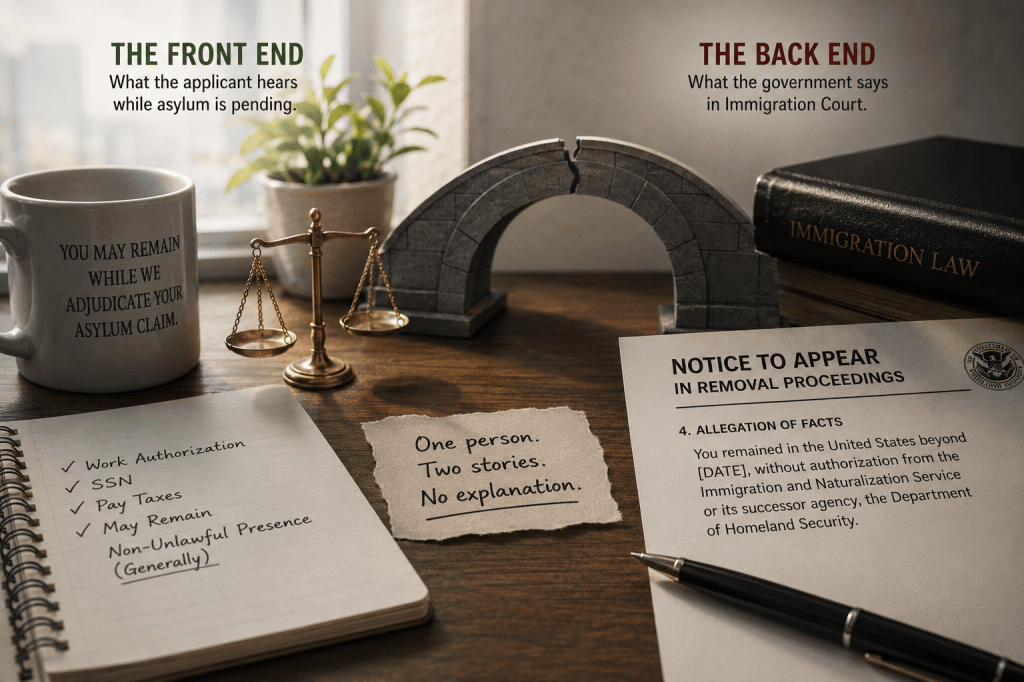
At the Institute for Migration and Human Rights (IMHR), we recently published a full legal analysis of a pattern that shows up constantly in asylum cases but that almost nobody outside immigration law ever notices: the government describes the same years of a person’s life in two completely different ways, depending on which part of the government is talking. In this post, I want to walk through a few of the key ideas from that analysis, using the example that makes the problem easiest to see, what’s actually written in a Notice to Appear.
If you’ve ever read a Notice to Appear, the document that starts a removal case in Immigration Court, you’ve probably skimmed past four short numbered paragraphs near the top. Allegation four usually reads something like this:
“You remained in the United States beyond [date], without authorization from the Immigration and Naturalization Service or its successor agency, the Department of Homeland Security.”
Let me be precise about something first, because it matters: that allegation is legally accurate. A pending asylum application does not create or extend lawful immigration status. If the visa classification someone was admitted under expired and nothing replaced it, the government can charge removability on that basis. That’s settled law. Our analysis doesn’t dispute it.
What we’re pointing to is something different, and we’d argue more important: the government tells this story in two completely different languages, depending on which part of the government is speaking, and it never explains the connection between them.
The front end
While an asylum case is pending, this is what an applicant actually hears from the government:
- “You may remain while we adjudicate your asylum claim.”
- “You may obtain work authorization.”
- “You may receive a Social Security number.”
- “Your bona fide pending asylum time generally does not count as unlawful presence.”
The government knows exactly where this person is. It renews her documents, repeatedly, tied to the very case it has left undecided. It authorizes her to work, and she does, and pays taxes on that income, year after year.
The back end
Then, if the case is eventually referred to Immigration Court, that same government pivots to a completely different vocabulary: your status expired, nothing replaced it, you are removable, and the years since that expiration were, as far as this proceeding is concerned, simply unauthorized.
Nobody along the way said: “By the way, although we’re allowing all of this, for another statutory purpose we will continue treating your immigration status as having expired years ago, and that will eventually become the basis for a removal charge.”
Not advice on how to plead
This isn’t a suggestion that you should dispute the fourth allegation if you’re the one facing it in court. In practice, immigration attorneys very often advise clients to admit it, for reasons that have nothing to do with whether the government’s language is precise. The underlying dates, admission and expiration, are usually easy for DHS to prove regardless. And immigration judges are now generally barred by regulation from ending a case just so someone can pursue asylum before USCIS instead, so denying the allegation doesn’t reliably get anyone closer to an asylum decision, it can just end the case with nothing resolved. Whether and how to plead to anything in a Notice to Appear is a decision to make with a licensed immigration attorney, not from a blog post.
Why this matters more the longer it takes
If this gap surfaced after six months, it would barely register. But asylum cases routinely take years, sometimes a decade, past the 180-day target Congress originally set. During that time, a person doesn’t just wait. He works. He raises children. He earns degrees. He builds a life openly, in continuous, repeated contact with the same federal government that will later describe his presence during all of it as unauthorized.
A different vocabulary would fix a lot of this
Instead of forcing every case into a binary of “lawful status” or “unauthorized,” immigration law could recognize a third category, something like authorized protective stay, describing someone who doesn’t hold status but whom the government has affirmatively permitted to remain while a protection claim is pending. That wouldn’t change anyone’s eligibility for anything. It wouldn’t touch § 237. It would simply stop using language that implies something that isn’t true.
Why this is worth writing about
Each piece of this system, on its own, makes sense to an immigration lawyer. Unlawful presence exists for one purpose. Status matters for another. Employment authorization serves a different function entirely. Asylum-pending protection reflects yet another obligation. Put them all together around one actual person, though, and you get something that sounds, to almost anyone outside the field, absurd: you aren’t in status, you aren’t accruing unlawful presence, you’re authorized to work, you may remain while we decide your case, we may take ten years to decide it, and at the end of those ten years, we can charge you with overstaying the status that expired while we were still deciding whether to protect you.
That gap, between what’s legally intelligible to specialists and what’s coherent to the person actually living it, is exactly where we think legal scholarship should look.
Read the full analysis
This post only scratches the surface. The full legal analysis, Authorized to Remain, But Not in Status, walks through the doctrinal sourcing, the fair-notice and reliance argument in more depth, and specific recommendations for how USCIS, DHS, and Congress could fix this, without changing anyone’s underlying eligibility. If you work on this issue in Congress, at DHS, or in the courts, I’d genuinely welcome you reading it in full.
This post is provided for general informational purposes and does not constitute legal advice. If you are facing removal proceedings, please consult a licensed immigration attorney.


Leave a Reply