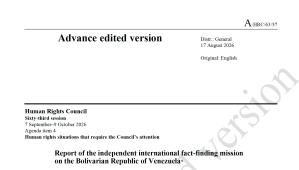
On September 16, 2026, the UN Independent International Fact-Finding Mission on Venezuela released its latest report to the Human Rights Council. Document A/HRC/63/57 covers September 1, 2025 through July 31, 2026, the period that includes the U.S. military operation of January 3 that led to Nicolás Maduro’s capture and removal from power after more than a decade in office.
For a lot of people watching from outside, that operation looked like the end of the story. The dictator is gone. Prisoners are being released. An interim president has promised a “new political moment.” It is a tidy version, and parts of it are true. It is also not what the United Nations’ own fact finding body found when it went looking.
This post is not new research. It is confirmation of what this platform has been documenting since Maduro’s capture: that removing one man from power did not dismantle the system built to keep him there. The UN mission’s own words, published in its own report, now say so directly.
What the mission actually found
The report’s structure is worth sitting with before its conclusions, because the mission did not set out to argue that nothing changed. It documents real developments. A significant decline in long term political detentions and enforced disappearances after January. The closure of El Helicoide, the intelligence facility long used for detention and torture. An amnesty law. A verified 1,099 releases between September 2025 and the report’s writing, out of a government claimed 1,521. A surge in public protest, with the Observatorio Venezolano de Conflictividad Social recording 1,926 demonstrations in the first quarter of 2026 alone, a 144 percent increase over the same period the year before (A/HRC/63/57, paras. 30, 57, 62 to 64).
Then the report turns to what did not change, and this is where its findings confirm the thesis this platform has carried since the transition began.
The people did not change. “Interim President” Delcy Rodríguez held senior Cabinet positions under Maduro from 2014 onward, including formal oversight of the Bolivarian National Intelligence Service (SEBIN), one of the two institutions the mission identifies as the principal instrument of political repression (para. 34). Her brother, Jorge Rodríguez, remains president of the National Assembly, a position from which the mission says he was “instrumental in advancing legislation enabling political persecution” (para. 35). Diosdado Cabello, whom the mission has linked in previous reports to serious human rights violations, continues to run the interior ministry (para. 39). Vladimir Padrino, defense minister for over a decade, was reassigned to a new Cabinet post rather than investigated (para. 38).
The institutions did not change. SEBIN and the Directorate-General of Military Counter-intelligence (DGCIM) “continue to operate under the same structures and with the same rules.” The Bolivarian National Guard has undergone no organizational reform, no internal review, and no disciplinary process (para. 46).
The legal framework did not change. The 2017 constitutional law against hatred, used for years to prosecute dissent, remains in force. So does the 2024 law restricting non-governmental organizations, which the mission itself has previously called a mechanism of political control (paras. 41 to 42).
Accountability did not happen. No senior official implicated in past violations has been investigated or prosecuted. In July 2026, Venezuela formally withdrew from the Rome Statute of the International Criminal Court, a decision the mission notes was “publicly supported by the United States” (para. 51).
The mission’s own conclusion states it without qualification: the measures of political liberalization adopted since January 3 “remain partial, conditional and reversible at best,” and the mission is “not confident that they represent a genuine and sustainable departure from the State policy of repression, rather than a tactical adjustment” (para. 106).
The prisoners who remain
Between 379 and 500 people remained in state custody for political reasons at the time of the report’s writing, according to figures the mission cites from Venezuelan civil society organizations (para. 65). The report documents what is still happening to them.
Alfredo Díaz, leader of the opposition party Acción Democrática and former governor of Nueva Esparta State, was arbitrarily detained in November 2024 and held incommunicado for nearly ten months without medical treatment despite showing serious symptoms of illness. He died in custody at El Helicoide on December 6, 2025. No investigation into his death has been conducted (para. 55).
Víctor Hugo Quero, a street vendor, was detained on January 1, 2025 and forcibly disappeared. His 81 year old mother, Carmen Teresa Navas, spent more than sixteen months trying to learn what had happened to him. In May 2026, authorities finally acknowledged that he had died in July 2025, and had been buried without notifying his family. Ms. Navas died ten days after learning of her son’s death (paras. 68 to 69).
At El Rodeo I and Fuerte Guaicaipuro prisons, the mission documents forced intubation and catheterization of hunger strikers, prolonged confinement in underground cisterns detainees called the “time machine,” and food deliberately withheld or contaminated (paras. 73 to 80). These are not incidents from the Maduro years cited for historical context. The mission states plainly that testimony confirms the practices “continued well into 2026” (para. 74).
The colectivos: now documented as state apparatus, not just tolerated actors
This platform has previously covered the role of colectivos, the armed pro-government civilian groups that trace back to the 1960s and were formally absorbed into state strategy after the 2002 coup attempt against Hugo Chávez. The mission’s new report moves this from documented pattern to formal legal finding.
The mission concludes that colectivos receive funding through state payrolls, access to seized assets, weapons, and communications equipment, in direct exchange for enforcing political loyalty (paras. 90 to 92). They administer access to food distribution programs, monitor residents through official population databases, and feed identifying information directly into arbitrary detentions (para. 93). In areas under their control, they exercise informal judicial authority over community disputes (para. 97).
The legal conclusion matters most. Where colectivos act on the instructions of, or under the direction or control of, state organs, the mission finds their conduct is legally attributable to Venezuela under international law, meaning the resulting violations are internationally wrongful acts of the state itself, not merely the acts of loosely affiliated militias the state failed to control (para. 102).
Why this is confirmation, not a new argument
None of this should read as a surprise to anyone who has followed this platform’s coverage since January. What changes with this report is the source. This is not a Venezuelan civil society organization, an exile advocacy group, or a foreign ministry with its own interests in the outcome. It is the United Nations’ own independent investigative body, using its own methodology, reaching the same conclusion documented here since the earliest weeks of the transition: institutional repression has not ceased.
The mission goes further than confirming the pattern. It states directly that Venezuelans who have fled the country remain in need of international protection, precisely because the conditions that caused their displacement have not been resolved (para. 106). For anyone building a record of current country conditions, that sentence, from the UN’s own fact finding mission, dated September 2026, is as direct a statement as this process is likely to produce.
Maduro’s absence is not evidence of safety
There is a narrative taking hold, in some corners of the diaspora and in parts of the international conversation, that Venezuela’s crisis effectively ended on January 3, 2026. Maduro is gone. A new government is talking about coexistence. Surely, the reasoning goes, it is time to close the file: end the protections, stop calling it a humanitarian emergency, encourage people to go home.
The United Nations’ own fact finding mission just spent eighteen pages explaining why that reasoning does not hold. The same intelligence services that disappeared Víctor Hugo Quero still operate under the same rules. The same colectivos that the mission now formally links to the Venezuelan state still control who eats and who gets flagged as disloyal in the neighborhoods they run. The same officials who ran the machinery of repression for over a decade did not lose their jobs when Maduro lost his freedom. They were reassigned.
A change in who holds power is not the same as a change in how power is held. The mission said so in its own words: the liberalization since January is “partial, conditional and reversible at best,” not a genuine departure from the policy of repression (para. 106). That is not this platform’s interpretation. It is the finding of the body the international community itself created to answer exactly this question.
This matters because policy is being built on the other version of the story, the tidy one. Every argument to deny asylum claims on the theory that conditions have improved, to pressure the diaspora toward a return that is not yet safe, rests on the premise that Maduro’s capture fixed what was broken. It did not. The people who built and ran the repressive apparatus are still in office. The prisons where torture continues under 2026 testimony are still open. The legal instruments used to criminalize dissent are still on the books.
Venezuelans in the United States and around the world did not flee a man. They fled a system, and the United Nations has now confirmed, in its own investigation and its own words, that the system is still standing. Protection was never conditioned on Maduro remaining in power, and it should not be withdrawn because he no longer is. Until the mission itself can report that the apparatus has been dismantled rather than inherited, the case for continued protection does not weaken. It strengthens.
Sources
United Nations Independent International Fact-Finding Mission on the Bolivarian Republic of Venezuela, “Report of the independent international fact-finding mission on the Bolivarian Republic of Venezuela” (A/HRC/63/57), Human Rights Council, 63rd session, published September 16, 2026. https://www.ohchr.org/sites/default/files/documents/hrbodies/hrcouncil/sessions-regular/session63/a-hrc-63-57-auv.pdf
OHCHR, “Venezuela: Amidst limited political changes, country’s repressive apparatus remains intact, UN Fact-Finding Mission says,” press release, September 16, 2026. https://www.ohchr.org/en/press-releases/2026/09/venezuela-amidst-limited-political-changes-countrys-repressive-apparatus
Observatorio Venezolano de Conflictividad Social, first quarter 2026 protest data, as cited in A/HRC/63/57, para. 30.


Leave a comment