There is a version of the story that ends in January 2026. A dictator captured, prisoners walking free, exiles boarding flights home. It is a tidy version, and parts of it are true. But look at who is actually governing the country, who still controls the streets, who still runs the intelligence services, and who is actually allowed to come home, and a different picture emerges. The architecture that enforced 26 years of political control was never dismantled. It was inherited.
This piece looks at three pieces of that architecture that rarely make the English language headlines: who is actually in charge and what they did to get there, the armed civilian groups known as colectivos, and what happens to ordinary Venezuelans, not just famous exiled politicians, when they are sent back into this system. That last point matters beyond Venezuela’s borders. Whether a person facing return, voluntarily or not, can safely go back to a country depends on whether the state institutions that persecuted people have actually changed. As this piece lays out, they have not. The people who ran the machine still run it, and the machine is still doing what it was built to do.
The three people running the transition were part of the machine
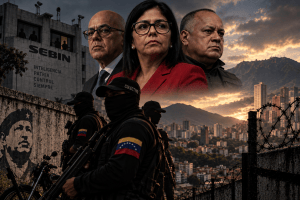
Before looking at colectivos or SEBIN as institutions, it helps to name who currently sits atop them, because none of the three are new to this. Delcy Rodríguez, Jorge Rodríguez, and Diosdado Cabello did not arrive with the transition. Each has a documented, sanctioned history inside the apparatus this piece is about.
Delcy Rodríguez, Maduro’s vice president since 2018 and acting president of Venezuela since his January 2026 capture, is the most important of the three precisely because she is now head of state. From 2018 until April 2021, she exercised direct hierarchical control over SEBIN, Venezuela’s intelligence service, according to reporting that draws on testimony former SEBIN Director General Cristopher Figuera gave the United Nations, in which he said he communicated with her “practically every day,” including updates on wiretaps and surveillance of politicians. Under her oversight, SEBIN detained opposition leader Freddy Guevara in 2021, two days after Rodríguez had publicly accused him of gang involvement. Before that, she served as president of the 2017 National Constituent Assembly, the body the European Union’s own restrictive measures decision (Council Decision (CFSP) 2017/2074) cites by name as a driver of “the continuing deterioration of democracy, the rule of law and human rights in Venezuela.” The U.S. Treasury designated her in September 2018, stating she had been given “senior positions within the Venezuelan government to help him maintain power and solidify his authoritarian rule.” She was sanctioned by the United States, European Union, Switzerland, and Canada, and remained under those sanctions until April 1, 2026, when the U.S. Treasury removed her from its Specially Designated Nationals list. Senators Jeanne Shaheen and Elizabeth Warren wrote to the administration in May 2026 questioning that decision, pointing out that the 2020 UN Fact-Finding Mission had found SEBIN, the agency she directly commanded, committed crimes against humanity, and that the Mission’s own March 2026 report concluded the structures responsible for repression remain intact.
Jorge Rodríguez, Delcy’s brother and president of Venezuela’s National Assembly since 2021, was sanctioned in the same September 2018 round for the same stated reason, helping Maduro consolidate authoritarian rule. Earlier in his career he served as mayor of Caracas’s Libertador municipality and as communications minister. As president of the National Assembly, the body under his leadership enacted the laws that current human rights reporting, including the EUAA’s July 2026 country report cited elsewhere on this site, identifies as the legal backbone of ongoing persecution: the Anti-Hate Law and the law restricting non-governmental organizations. He has also functioned for years as the government’s lead negotiator in talks with the opposition, in Oslo, Barbados, and Mexico City, which makes his more recent role, publicly attacking Foro Penal as a “political arm of the opposition” that “manipulates” its prisoner figures, and telling exiles to “get over it, forgive us, and come,” a continuation of the same function: managing the opposition and the diaspora on the government’s terms, not stepping back from repression so much as rebranding its public face.
Diosdado Cabello, Interior, Justice and Peace Minister since 2024 and one of the last Chávez era loyalists still standing after the transition, has the longest and most serious record of the three. He has hosted a weekly state television program, “Con el Mazo Dando,” that Amnesty International has criticized twice, in 2015 for using it to harass activists and again in July 2025 for his announcing a journalist’s arrest live on air. The UN Fact-Finding Mission’s reporting found that colectivos operated in coordination with security forces to repress protests, including firing warning shots without being stopped by nearby security personnel, and that Cabello, while still a National Assembly member in August 2024, warned journalists that publishing election results inconsistent with the government’s declared outcome would lead to arrest under what became known as Operation Tun Tun. The U.S. Department of Justice indicted him in March 2020 alongside Maduro on narco-terrorism, drug trafficking, and weapons charges, and the reward for information leading to his arrest was raised to $25 million in 2026. OFAC has sanctioned him since 2018 under the executive order targeting Venezuelan officials tied to democratic erosion and human rights abuse, and he remains on that list, along with EU and Canadian sanctions dating back further. As interior minister, he now holds cabinet level authority over the police, and by most outside assessments, including the International Crisis Group’s, continues to have real influence over intelligence services and colectivos as well.
Taken together, these are not three officials who inherited a repressive system from someone else and are now, to varying degrees, managing its wind down. Two of them ran pieces of it directly. The third continues to run a piece of it today. That is the context worth holding onto for everything that follows about colectivos, SEBIN, and who does and does not get to come home.
What colectivos are, and why they still matter
Colectivos are armed civilian groups, some with roots going back to community organizing before Hugo Chávez took power, that function as an informal enforcement arm alongside the formal security state. They are not a fringe phenomenon. A Venezuelan civil society explainer on the state intelligence apparatus describes SEBIN’s coordination with the DGCIM, the National Guard, and armed colectivos as following directives from what it calls the “political-military high command,” meaning the boundary between party, government, and armed groups in the street is, in practice, blurred rather than firm.
The United Nations Independent Fact-Finding Mission on Venezuela has reached similar conclusions from the outside. Its reporting has described SEBIN and DGCIM as “well-coordinated structures” carrying out a plan “orchestrated at the highest levels of government” to repress dissent, and a Fact-Finding Mission report from December 2025 named colectivos specifically, alongside DGCIM, SEBIN, and the National Guard, among the institutions implicated in a state policy of repression.
None of this stopped when Maduro was captured. In February 2026, a video circulated widely on WhatsApp and Telegram claiming that Secretary of State Marco Rubio had ordered SEBIN and DGCIM dismantled. Venezuelan fact checkers at Efecto Cocuyo traced the claim to a real but unrelated decree eliminating a handful of minor state bodies, and confirmed that as of early March 2026, SEBIN and DGCIM remained fully operational, continuing their intelligence, counterintelligence, and political surveillance functions under the interim government of Delcy Rodríguez. SEBIN remains attached to the vice presidency; DGCIM remains under the Ministry of Defense.
Colectivos, for their part, are not sitting on the sidelines of the post-Maduro power struggle, they are participants in it. Analysis from InsightCrime in February 2026 named the specific groups still active and organized: La Piedrita and Tres Raíces, consolidated under something called the Sergio Rodríguez Collectives Front, concentrated in the 23 de Enero neighborhood a few blocks from the presidential palace, along with the Cuadrillas de Paz network that Maduro built, which continues to control territory in Caracas and other major cities. The analysis frames these groups as a potential tipping factor if internal rivalries within Chavismo, particularly between Interior Minister Diosdado Cabello and the Rodríguez siblings now running the government, break into open conflict. A former U.S. ambassador to Venezuela told NPR in February 2026 that Washington should be demanding the disbandment of colectivos as a condition of further engagement, precisely because that demand has not been met and the groups remain intact, armed, and controlling neighborhoods.
In other words: the people who enforce political loyalty in Caracas’s streets, and the agencies that decide who gets watched, detained, or disappeared, are the same people and the same institutions as before. A new face in Miraflores did not require a new security apparatus. It inherited one.
Who gets to come home, and who does not
Since the amnesty law took effect in February 2026, the return of exiled Venezuelans has become one of the most visible and most contested developments of the transition. It is also more selective, and more revealing, than it might first appear.
A number of opposition figures have, in fact, returned. Yon Goicoechea, a Voluntad Popular leader who spent 14 months imprisoned before eight years in exile, came back on May 21, 2026, telling reporters “the moment to bet on Venezuela is now.” Rocío San Miguel, a military affairs specialist who spent nearly two years detained, much of it incommunicado at SEBIN’s El Helicoide facility, returned in May, though she still faces precautionary legal measures. Freddy Superlano, Carlos Ocariz, Lester Toledo, and Marcos Velazco have also returned, mostly rank and file or mid-tier opposition figures rebuilding a political presence inside the country.
But the government has drawn a clear line, and it runs precisely through the movement’s most recognizable leadership. Infobae reported in May 2026, without ambiguity, that the Chavista government does not admit the return of María Corina Machado, the Nobel Peace Prize winning opposition leader, or of Edmundo González Urrutia, the candidate who ran against Maduro in the disputed 2024 election, or of Leopoldo López and Julio Borges, the founders of Voluntad Popular and Primero Justicia. What looks from a distance like an open door is, as the same report puts it, in practice barely a crack.
That selectivity became a public flashpoint in May 2026, when National Assembly President Jorge Rodríguez, addressing the diaspora on television, said: “And if there is a Venezuelan abroad who harbors some form of resentment in their heart, we tell them: get over it, forgive us, and come. You will always be better off in your homeland.” The backlash was immediate and came overwhelmingly from the diaspora and human rights advocates, not from the regime’s base. Gustavo Lainette, founder of the NGO Resistencia Venezolana, responded: “After the bloodshed, the murdered students, the political prisoners, the persecution and the looting, now they ask for forgiveness as if nothing happened? No, Jorge Rodríguez, this cannot be overcome.” Freddy Superlano, freed under the same amnesty law Rodríguez was promoting, said those telling people to “get over it” have no idea of the damage done to more than eight million people. A migrant in Colombia told El Tiempo she could not forgive men she watched order live fire on protesters. Human rights researcher Murillo, quoted in the same coverage, drew a sharper legal point: forgiveness is the exclusive prerogative of those who directly suffered the violations, and a genuine process of social healing requires truth, justice, and reparation, not the imposition of forgiveness from above.
That is the first thread: a government asking the very people it persecuted to simply move on, without an accompanying process of accountability, and being told plainly that this is not reconciliation, it is impunity with better public relations.
The other resistance: from inside Chavismo itself
The second thread is less visible internationally, and arguably more important for understanding where the country is actually heading. It is not the exiles refusing to forgive the regime. It is a faction of the regime’s own base refusing to forgive the exiles, or more precisely, refusing to accept any negotiation with them at all.
Reporting from Caracas in early August 2026 documented government aligned demonstrators explicitly rejecting any dialogue or negotiation process with the opposition, a position openly at odds with the diplomatic opening Delcy Rodríguez’s government has been pursuing with U.S. mediation. One protester, Aidé Romero, was quoted directly: “We do not agree with a dialogue with the vendepatrias. For us this is another earthquake, a political earthquake.” Vendepatria is a loaded term in Venezuelan political language, meaning someone who sells out or betrays the homeland, and it is the word being used, from within Chavismo, against the idea of talking to the opposition at all, let alone welcoming its leaders home.
This matters for two reasons. First, it shows that the “traitors” framing that shapes how some regime supporters talk about the opposition and the diaspora is not simply top down propaganda handed down from Miraflores. It has genuine grassroots traction within the Chavista base, independent of and in some tension with the government’s own more conciliatory public messaging. Second, it helps explain why the government’s actual policy on returns looks the way it does: generous enough to rank and file opposition figures to claim credit for reconciliation, but firmly closed to Machado, González, López, and Borges, the names that would most inflame exactly this base.
Put together, what emerges is not a simple binary of a repressive regime versus a returning opposition. It is a government managing two audiences at once: performing openness for an international community and a U.S. administration pushing for reform, while holding a hard line against both its own most committed base and the opposition’s most threatening leaders. Colectivos, SEBIN, and DGCIM are the tools that make holding that line possible. They did not need new orders to keep functioning. They were simply never told to stop.
What deportees come home to
There is a third category of return that gets far less attention than exiled political leaders, and it matters most, because it is the category most people facing removal to Venezuela actually belong to: ordinary Venezuelans, not opposition figures, not public names, who do not choose to come home and who, on arrival, are handed directly into SEBIN custody. What happens to them there is the clearest evidence available that returning to Venezuela does not mean returning to an ordinary life.
On June 24, 2026, Flight 164 landed at Simón Bolívar International Airport carrying 146 or 147 Venezuelans deported from the United States, including 19 women and seven children, according to reporting from NPR, CNN, and the Washington Post that later reconstructed the group’s final hours. They were processed through the Venezuelan government’s Gran Misión Vuelta a la Patria program and taken into the custody of the Bolivarian National Intelligence Service, SEBIN, and the DGCIM, which loaded them onto buses bound for what officials called Hotel Santuario La Llanada in La Guaira. The building was not, in fact, a hotel. The Washington Post traced its history: built around 1960 as a Catholic school, later a youth residential facility, later a drug rehabilitation center, and during the pandemic a quarantine site. It was, in the Post’s description, a “spare government facility,” and on the night the deportees arrived, it was where SEBIN held them while their paperwork was processed.
This was not informal or improvised custody. Laura Cristina Dib, WOLA’s director for Venezuela, testified before the Tom Lantos Human Rights Commission that WOLA president Carolina Jiménez Sandoval had personally visited that hotel before the earthquakes struck and confirmed with her own eyes that the deportees inside were handcuffed. Dib told the Commission there is no information on how many of those detained survived, and that WOLA’s subsequent attempts to access the site were blocked, with SEBIN preventing even family members from searching for their relatives under the rubble.
Hours after the deportees arrived, two earthquakes measuring 7.2 and 7.5 struck within seconds of each other. The four story building collapsed. According to reporting compiled by the World Socialist Web Site from official and family accounts, of the 147 people inside, only 12 survived, and El País gathered testimony from another survivor in intensive care who described deportees screaming and begging SEBIN guards to open the doors as the shaking began. The guards did not open them. Survivor Ninoska Gutierrez told CNN she ran out barefoot as the wall beside her split apart. Families spent weeks searching hospitals, morgues, leaked passenger lists, and cellphone videos for answers, because neither the Venezuelan government nor the U.S. government released a complete manifest of who had been on the flight.
What survivor accounts describe is not a group being processed for release back into ordinary life. It is an interrogation. Pulzo and other outlets gathered anonymous survivor testimony describing that on arrival, deportees had their belongings and phones confiscated, including their passwords, so that officials could review their social media accounts, and that they were questioned specifically about their political leanings. Relatives of the dead, speaking to Infobae in August 2026, said their sons had been called “apátridas,” a slur meaning stateless traitors, and mistreated, despite having no criminal record. This is the actual content of what SEBIN and DGCIM custody involves for a returning Venezuelan: not a welcome, but a screening, one that examines a person’s connections, their political affiliations, their activity while abroad, and their family members and whereabouts, before the state decides what happens to them next. Daniely Hurtado, whose husband Osal Mujica was aboard and did not survive, told the Post that SEBIN officers later warned relatives not to speak publicly about the case, and Pulzo separately reported that families searching for the missing faced ongoing intimidation and threats from SEBIN throughout the process.
The pattern was not limited to one catastrophic night. A deportee who spoke to the Washington Post on condition of anonymity, describing the broader experience of returning under Venezuela’s repatriation program, put it this way: “When the cameras are rolling, they hug you. But once that’s done, they treat you like you’re a traitor for leaving the country.” That single line captures something the earthquake made visible by accident: the government’s welcome-home imagery, the photographs and video the Vuelta a la Patria program posts of returnees being embraced at the airport, sits over a process in which the same population is handcuffed, screened, interrogated about its politics, and in the state’s own internal language, treated as suspect for having left in the first place.
Deportation flights resumed on August 3, 2026, when Flight 165 brought 147 more Venezuelans back under the same program, still without a public accounting of what happened to everyone on Flight 164. Jiménez Sandoval said publicly that the resumption was deeply concerning given that authorities had not explained SEBIN’s role in the earlier tragedy or produced an official list of who from that flight had died, survived, or remained missing. Advocates quoted by el Nuevo Herald noted that deportees continue to be received by SEBIN agents who, in their words, go on to persecute them after arrival, a pattern the U.S. government has not factored into its deportation decisions.
This is also not happening in a vacuum. Separately, Human Rights Watch and the Salvadoran human rights organization Cristosal documented that Venezuelans the United States sent directly to El Salvador’s CECOT mega prison in March and April 2025, 252 people including dozens of asylum seekers, were subjected to torture, enforced disappearance, inhumane detention conditions, and in some cases sexual violence, and concluded these were systematic violations rather than isolated incidents by individual guards. The report frames the transfers as refoulement, sending people to a place where they would predictably face torture, and states plainly that the U.S. government bears responsibility for it.
Isabel Carlota Roby of RFK Human Rights and Laura Cristina Dib of WOLA both testified on this on July 15, 2026 before the same Tom Lantos Human Rights Commission hearing that examined Venezuela’s earthquake response and its underlying human rights crisis together, treating them, correctly, as a single emergency rather than two separate stories. The throughline across all of it is the same one running through this entire piece: whether the person returning is a Nobel laureate barred at the border or an ordinary deportee with no public profile at all, the institution deciding what happens to them next is SEBIN, and SEBIN answers to the same chain of command it always has.
The invitation is not the evidence
None of this changes because Delcy Rodríguez goes on television and asks the diaspora to come home. A call to return is a sentence. Country conditions are not built from sentences, they are built from institutions, and the institutions have not moved. The same colectivos still hold the same blocks of Caracas. The same SEBIN, under the same chain of command Rodríguez herself built between 2018 and 2021, still decides who is welcomed at the airport and who is quietly held, handcuffed, and questioned about their politics. The same DGCIM still answers to the Ministry of Defense it always has. The same Diosdado Cabello still sits in the Interior Ministry with real authority over the police and, by outside assessment, over the colectivos too. The social fabric this apparatus was built to control, through fear, through informants, through the ordinary expectation that a wrong word travels back to someone with the power to act on it, does not un-happen because a press conference says the door is open.
This is not only, or even mainly, a story about famous exiles. María Corina Machado and Edmundo González make headlines because the government explicitly bars them. The far larger population is the one Flight 164 and Flight 165 represent: people with no public profile at all, who left for economic or personal reasons rather than political ones, and who discover on arrival that the state still wants to know their connections, their political affiliations, what they did and said while abroad, and where their family members are, before it decides what to do with them. That screening process, not the amnesty law, not the televised invitations, is what actually governs a return to Venezuela today. A country’s institutions do not become safe for return because its acting president says so on TV. They become safe when the people running SEBIN, DGCIM, and the colectivos are no longer the same people who built those institutions to do exactly what they are still doing.
That is the honest way to read everything in this piece. Venezuela is not being governed by a transitional government feeling its way toward reform. It is being governed, in its security architecture if not always in its public messaging, by the same people who built the repressive machine and by the radicalized Chavista and Madurista base that still openly rejects any reckoning with the past. An invitation issued by that government is not evidence that conditions have changed. It is, at most, a claim, one that every other document cited here, from UN reports to sanctions files to a collapsed hotel in La Guaira, still contradicts.
Primary sources cited
- UN Independent International Fact-Finding Mission on the Bolivarian Republic of Venezuela, report on the Bolivarian National Guard and intelligence services, December 11, 2025: ohchr.org/en/hr-bodies/hrc/ffmv
- InsightCrime, “The Colectivos’ Role in the Struggle for Power in Post-Maduro Venezuela,” February 3, 2026: insightcrime.org
- Efecto Cocuyo, “Cocuyo Chequea” fact check on SEBIN and DGCIM dismantlement claims, March 4 to 5, 2026: efectococuyo.com
- NPR, “Venezuela’s interim leader navigates U.S. demands, Chavista loyalty,” February 5, 2026: npr.org
- The Conversation, “Venezuela’s civil-military alliance is being stretched,” April 29, 2026: theconversation.com
- Infobae, “Dirigentes opositores aprovechan la amnistía decretada por el chavismo para regresar a Venezuela,” May 26, 2026: infobae.com
- El Tiempo / GDA, “‘Supéralo, perdónanos y vente’: el chavismo busca reconciliación con venezolanos en el exilio,” May 7 to 8, 2026: eltiempo.com
- Curadas, “Grietas rojas: la base chavista alza la voz contra el diálogo con la oposición,” August 2 to 3, 2026: curadas.com
- Red Global Venezuela, explainer on SEBIN structure and coordination with DGCIM and colectivos: redglobalvenezuela.org
- Washington Post, “Deported by the U.S., detained in Venezuela, then lost in the earthquakes,” August 2, 2026: washingtonpost.com
- NPR, “Venezuelans deported from the U.S. were killed hours later in powerful quakes,” June 30, 2026: npr.org
- CNN, “Venezuelans deported by the US hours before the deadly earthquake struck are missing,” June 30, 2026, and “Man died in Venezuela earthquake a day after US deported him,” July 17, 2026: cnn.com
- WOLA, Carolina Jiménez Sandoval, public analysis of Flight 164 and Hotel Santuario, and statement on resumption of deportation flights, cited in Jefferson City News-Tribune / el Nuevo Herald, August 5, 2026: wola.org
- Human Rights Watch and Cristosal, “‘You Have Arrived in Hell’: Torture and Other Abuses Against Venezuelans in El Salvador’s Mega Prison,” November 12, 2025: hrw.org
- Robert F. Kennedy Human Rights, Isabel Carlota Roby testimony before the Tom Lantos Human Rights Commission, July 15, 2026: kennedyhumanrights.org
- WOLA, “Civil society organizations present recommendations to the United States Congress for a genuine democratic transition in Venezuela,” July 22, 2026: wola.org
- Yahoo News / independent reporting, “Venezuela’s Acting Dictator Is Delcy Rodríguez, a Maduro Regime Ally With a History of Human Rights Violations,” citing Cristopher Figuera’s UN testimony, January 6, 2026
- U.S. Department of the Treasury, press release designating Delcy Rodríguez, Jorge Rodríguez, Vladimir Padrino López, and Cilia Flores, September 2018 (archived at 2017-2021-translations.state.gov)
- Council of the European Union, Decision (CFSP) 2017/2074 concerning restrictive measures in view of the situation in Venezuela, November 13, 2017, and related EU General Court judgment (EUR-Lex, CELEX:62018TJ0553)
- Office of Senators Jeanne Shaheen and Elizabeth Warren, letter to Secretary Rubio and Secretary Bessent on sanctions relief for Delcy Rodríguez, May 2026: globalsecurity.org
- NPR and PBS NewsHour, “U.S. lifts sanctions on Venezuela’s acting President Delcy Rodríguez,” April 1 to 2, 2026
- Al Jazeera, “Who is Diosdado Cabello, Maduro’s interior minister and militia boss?,” January 7, 2026, citing UN Fact-Finding Mission findings on colectivo coordination with security forces and Operation Tun Tun
- CNN, “What to know about Diosdado Cabello, Venezuela’s powerful interior minister who may be in jeopardy next,” January 7, 2026
- U.S. Department of Justice, Southern District of New York, narco-terrorism indictment of Maduro, Cabello, and others, March 26, 2020: justice.gov
- U.S. Department of the Treasury, press release on sanctions and reward increases for Maduro, Cabello, and Padrino, January 2025: home.treasury.gov
- OCCRP, “Cabinet of the Blacklisted: Sanctioned Loyalists Take Charge of Venezuela’s Quake Relief,” June 29, 2026
- El Nacional and Dossier Venezuela, “Organizaciones y congresistas de EE UU presionan por el TPS para venezolanos tras los terremotos,” reporting Laura Cristina Dib’s (WOLA) Tom Lantos Human Rights Commission testimony that WOLA president Carolina Jiménez Sandoval personally confirmed deportees were handcuffed at Hotel Santuario before the earthquake, July 22, 2026: elnacional.com, dossiervenezuela.com
- World Socialist Web Site, Spanish edition, “Deportados de Estados Unidos mueren en terremoto venezolano,” including El País survivor testimony of deportees begging SEBIN guards to open the doors, July 1, 2026: wsws.org
- Pulzo, “Deportados afectados por doble terremoto en La Guaira,” survivor testimony on confiscated phones, political interrogation, and continuing SEBIN intimidation of searching families, cited via France 24 sourcing, August 2026: pulzo.com
- Infobae, “Las madres de los deportados muertos en el terremoto denuncian: ‘Que hayan estado en ese sitio es culpa del Sebin,’” August 24, 2026: infobae.com
- France 24, “Venezuela: deportación y terremoto, la doble desgracia del vuelo 164,” survivor and family testimony, August 18, 2026: france24.com


Leave a Reply