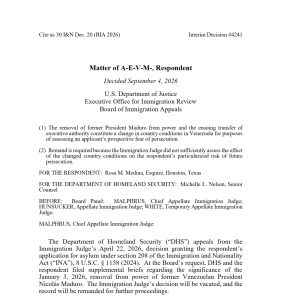
On September 4, 2026, the Board of Immigration Appeals issued Matter of A-E-V-M-, 30 I&N Dec. 20 (BIA 2026), a precedential decision that will be important for Venezuelan asylum cases going forward.
As with any newly issued precedential decision, we do not yet know how Matter of A-E-V-M- will be used or applied in future Venezuelan asylum cases. Its practical reach will become clearer as DHS, Immigration Judges, and the BIA itself apply the decision to cases involving different facts and procedural circumstances. This article does not attempt to predict those future applications or argue how any particular case should be decided. Its purpose is more straightforward: to explain what the BIA decided, what it did not decide, and which parts of the ruling are important to understand going forward.
The decision has a headline that can easily be misunderstood. The BIA held that Nicolás Maduro’s removal from power and the transfer of executive authority constitute a change in country conditions in Venezuela for purposes of evaluating an asylum applicant’s prospective fear of persecution.
That does not mean the BIA declared Venezuela safe. It does not mean the Board found that political persecution has ended. It does not mean that the institutions associated with repression under Maduro have disappeared.
And it does not mean that Venezuelans who opposed the Maduro government can no longer establish a well-founded fear of persecution.
In fact, the decision itself expressly recognizes that a change in national leadership does not necessarily eliminate a well-founded fear. The BIA explains that officials, institutions, security forces, and other actors associated with the former government may continue to exercise authority after a change in national leadership.
That part of the decision is particularly important in the Venezuelan context.
Maduro is no longer in power, but many of the people and institutions that exercised power during his government remain. Delcy Rodríguez, Jorge Rodríguez, and Diosdado Cabello are not new political figures who arrived after Maduro to dismantle a system created by someone else. They occupied central positions within that system for years, and in some cases for decades.
The same question extends beyond individual officials. SEBIN, DGCIM, security forces, colectivos, and other actors associated with political repression cannot be treated as interchangeable with the person occupying the presidency.
That distinction is important to understanding what Matter of A-E-V-M- actually says.
What happened in Matter of A-E-V-M-?
The respondent is a native and citizen of Venezuela who entered the United States as a nonimmigrant student on July 27, 2014.
In 2015, her spouse filed an Application for Asylum and Withholding of Removal, Form I-589, with USCIS and included her as a derivative beneficiary.
DHS later placed her in removal proceedings, charging her with failing to maintain or comply with the conditions of her nonimmigrant status. She conceded removability. On March 19, 2026, she filed an asylum application in her own name.
Her asylum claim was based on her political opinion in opposition to the Maduro government.
She testified that she and her husband belonged to pro-democracy political groups and participated in opposition activities in Venezuela. According to her testimony, they were threatened and intimidated by people she believed supported the Maduro government and by a government official at the University of Carabobo. Her husband was also assaulted.
She further testified that Venezuelan authorities annulled her passport in October 2025. While living in the United States, she continued expressing her opposition to Maduro through social media.
The Immigration Judge found her credible.
The judge did not find that her previous experiences rose to the legal level of past persecution. The judge nevertheless concluded that she had established a well-founded fear of future persecution on account of her political opinion and granted asylum.
DHS appealed.
By then, a significant political event had occurred in Venezuela. Maduro had been removed from power on January 3, 2026.
The BIA asked both parties to submit supplemental briefs addressing the significance of Maduro’s removal to the respondent’s asylum claim. The Board ultimately vacated the Immigration Judge’s decision and remanded the case for further proceedings.
Why do current country conditions matter in an asylum case?
When an asylum claim depends on fear of future persecution, the inquiry is necessarily forward-looking.
The question is not only what happened in the applicant’s country before the person left. The adjudicator must determine whether the applicant has an objectively reasonable fear of persecution if returned under the circumstances that exist now.
The BIA explains in A-E-V-M- that conditions existing when an applicant departed the country cannot be considered in isolation. Subsequent political developments may affect whether a fear of future persecution remains objectively reasonable.
This principle did not originate with this case.
The Board discusses several of its previous decisions involving changed political circumstances. For example, in Matter of R-R-, the BIA considered that the Sandinista Party no longer controlled Nicaragua. It also cites decisions involving political stabilization and changes in the influence or capacity of persecuting organizations.
A-E-V-M- applies that existing principle to the current situation in Venezuela.
What exactly did the BIA hold about Venezuela?
The BIA held that Maduro’s removal and the resulting transfer of executive authority constitute changed country conditions for purposes of assessing prospective fear of persecution.
The Board reasoned that when an applicant’s claimed fear arises from opposition to a government headed by a particular leader, the removal of that leader and transfer of executive authority alter the political circumstances against which the applicant’s future fear must be evaluated.
The BIA characterized the removal of the head of a national government as a “very significant development.”
That is the precedential holding. Understanding what the Board did not decide is equally important. The BIA did not hold that Maduro’s removal necessarily eliminated this respondent’s fear of persecution. It did not find that the institutions or individuals she feared had disappeared. And it did not ultimately decide whether she would be persecuted if returned to Venezuela.
Instead, the Board concluded that additional factual analysis was necessary.
The respondent’s argument focused on what remained after Maduro
The respondent did not dispute the fact that Maduro had been removed from power. Her argument focused on what remained.
As the BIA describes her position, she argued that the “structural, state-sponsored apparatus of persecution and torture in Venezuela remains fully intact” and that the military, intelligence, and paramilitary networks that existed under Maduro remained controlled by longstanding Maduro loyalists.
This distinction is central to understanding the decision. There is a difference between saying that Maduro remains in power and saying that the people and institutions through which political repression occurred may remain in positions of power after Maduro.
The BIA expressly recognizes that distinction. The Board states that “a change in national leadership does not necessarily eliminate a well-founded fear of persecution.” It explains that evidence showing that officials, institutions, security forces, or other actors associated with the former government continue to exercise authority may be relevant to determining whether an applicant remains at risk.
In other words, the analysis does not necessarily end with the identity of the person occupying the presidency.
It may require looking at who continues to exercise power throughout the state.
Who is exercising power in Venezuela now?
This is where the current structure of power in Venezuela becomes particularly relevant.
Delcy Rodríguez, Jorge Rodríguez, and Diosdado Cabello are not new political figures who arrived after Maduro’s removal. They occupied central positions within the political system that existed under Chávez and Maduro for years, and in some cases for decades.
The same question extends beyond individual officials to the institutions and actors associated with political repression, including SEBIN, DGCIM, security forces, and colectivos.
That continuity matters in light of the BIA’s own recognition that a change in national leadership does not necessarily eliminate a well-founded fear of persecution. The Board specifically explains that officials, institutions, security forces, and other actors associated with a former government may continue to exercise authority after a leadership change.
For a detailed examination of who currently holds power in Venezuela, their roles under the Chávez and Maduro governments, the continued operation of the intelligence and security structures, the colectivos, and what the available evidence shows about returnees, see my previous article, The Same Hands: Colectivos, Intelligence Services, and the Politics of Return in Venezuela.
That broader country-conditions analysis provides important context for the factual questions that Matter of A-E-V-M- now places at the center of the future-persecution inquiry.
Why did the BIA remand the case?
Understanding this part of the decision is important because the BIA did not make a factual finding that the institutions associated with the Maduro government had disappeared.
The Immigration Judge had concluded that the “essence of the Maduro government remains” and that the “Maduro regime has not disappeared.”
The BIA found that those statements, standing alone, did not contain sufficient factual findings to support the analysis of the respondent’s prospective risk. The Board described them as “largely conclusory and devoid of factual findings.”
The Board identified several areas where additional factual analysis was needed. For example, the Immigration Judge relied in part on the cancellation of the respondent’s and her husband’s passports. But those cancellations occurred in 2025, while Maduro remained in power.
The Immigration Judge also referred to laws enacted during the Maduro period that were used against political dissent. The BIA noted, however, that the record did not establish whether those laws continued to be enforced under the current political circumstances.
The Board therefore concluded that additional factual findings were necessary. In particular, the BIA said the Immigration Judge had not sufficiently addressed whether the individuals or institutions the respondent fears “remain as before and are able and interested in targeting her in the current political environment.”
That sentence is one of the most important in the decision for understanding its practical effect. The question is not simply whether Maduro-era institutions continue to exist. The analysis must connect those current conditions to the particular asylum applicant.
What does this mean for country-conditions evidence?
For Venezuelan asylum applicants relying on future persecution, A-E-V-M- makes current evidence particularly important.
Historical evidence remains relevant. Evidence documenting what SEBIN, DGCIM, colectivos, police agencies, military officials, or other actors did in previous years can explain the nature of those institutions, establish patterns of conduct, corroborate an applicant’s experiences, and help identify the actors connected to the feared harm.
But where the claim depends on what could happen upon return today, the evidence also needs to address the present.
If an applicant fears SEBIN, does SEBIN remain operational? Who controls it? If an applicant fears DGCIM, what authority does DGCIM possess today?
If colectivos participated in threats or persecution, do those groups remain active? Do they retain the capacity to act? What relationship, if any, do they currently maintain with state authorities?
If an applicant was targeted under laws used against political dissent, are those laws still in force? Are they still being enforced?
If an applicant fears a particular official, institution, security body, or political organization, does that actor retain the ability to identify, locate, detain, threaten, or otherwise harm the applicant?
And then comes the individualized question emphasized by the BIA:
Why do those current conditions create a risk to this particular person?
That connection between country conditions and the individual applicant is essential.
Continuity is therefore part of the factual inquiry
This point deserves emphasis.
When examining Venezuela after Maduro’s removal, continuity in personnel and institutions is not merely historical background. It goes directly to an inquiry identified by the BIA itself.
Delcy Rodríguez, Jorge Rodríguez, and Diosdado Cabello did not arrive after Maduro’s removal as representatives of an entirely separate political structure replacing the people who previously exercised power.
They were themselves among the people exercising that power.
The same factual inquiry applies to SEBIN, DGCIM, police and military structures, colectivos, and other actors associated with political repression.
Their continued existence alone does not determine the outcome of an asylum case. But their current leadership, authority, capacity, conduct, and relationship with the government may be highly relevant to whether an applicant continues to face a risk.
A change in the person occupying the presidency and a change in the institutional apparatus of the state are not necessarily the same thing.
A-E-V-M- holds that the first constitutes changed country conditions. The decision itself recognizes that the continued authority of the second may still matter.
What other developments did the BIA consider?
The BIA’s discussion was not limited to Maduro’s removal.
The Board also discussed the influence of the United States on Venezuela’s Interim Government. It took administrative notice of developments including the restoration of full diplomatic relations, the reopening of the U.S. Embassy in Caracas, continued cooperation between the United States and the Interim Government, and U.S. government statements regarding a three-part plan involving stabilization, economic recovery, and democratic transition.
The BIA also discussed State Department statements concerning political reconciliation and a transition toward democratic elections involving the Interim Government and the 2015 National Assembly.
Those developments formed part of the current political circumstances considered by the Board.
At the same time, the BIA’s own framework still requires an individualized assessment of the actors and institutions connected to the applicant’s feared persecution.
Diplomatic relations, political negotiations, economic cooperation, and discussions of democratic transition describe one part of current country conditions.
The continued authority, capacity, and conduct of security institutions, intelligence bodies, political officials, colectivos, and other actors potentially capable of persecution describe another.
Both may be relevant to the analysis.
What about invitations for Venezuelans abroad to return?
This issue may also become increasingly important in evaluating country conditions.
Public invitations encouraging Venezuelans abroad to return can be relevant to understanding the government’s stated position toward the diaspora. But an asylum claim ultimately involves an assessment of what may happen to the particular applicant.
What happens when someone actually returns? How are returnees processed? Are political activities conducted abroad known to Venezuelan authorities? Are returnees questioned about those activities? Do intelligence or security authorities retain information about the applicant?
Are similarly situated people being detained, questioned, surveilled, threatened, or otherwise targeted? Do the institutions previously responsible for those actions retain the ability to carry them out?
A public invitation to return is one piece of information.
The actual treatment of returnees is another. For an asylum applicant, that distinction can be critical.
Past persecution changes the burden analysis
There is another important part of A-E-V-M- that should not be overlooked.
The Immigration Judge found that this respondent had not established past persecution.
That finding affected the burden of proof. Because she had not established past persecution, the respondent bore the burden of establishing a well-founded fear of future persecution.
The BIA specifically distinguishes that situation from cases in which an applicant has established past persecution. When past persecution is established, the regulations provide a presumption of future persecution. DHS then bears the burden of establishing a qualifying fundamental change in circumstances sufficient to rebut that presumption.
That distinction matters when reading A-E-V-M-. The BIA held that Maduro’s removal constitutes changed country conditions relevant to prospective fear.
The decision did not hold that Maduro’s removal automatically establishes the fundamental change in circumstances necessary to rebut the regulatory presumption in every Venezuelan asylum case where past persecution has been established.
Those are different questions, with different burdens.
A separate issue: the one-year asylum filing deadline
A-E-V-M- also addresses a second legal issue that is separate from the Venezuela country-conditions analysis.
The respondent entered the United States in 2014. Her spouse filed an asylum application in 2015 and included her as a derivative beneficiary. But the respondent did not file an I-589 in her own name until March 19, 2026.
The Immigration Judge granted asylum without first determining whether her individual asylum application satisfied the one-year filing requirement or whether she qualified for an exception.
The BIA concluded that this threshold issue needed to be addressed on remand. Importantly, the Board did not hold that the respondent’s application was necessarily time-barred.
It remanded for the Immigration Judge to determine whether the application was timely or whether the respondent could establish an applicable exception under the asylum regulations.
This part of the decision may be particularly important for people who spent years as derivative beneficiaries on a spouse’s or parent’s asylum application and later need to pursue asylum independently.
The fact that someone was previously included as a derivative in another person’s asylum case does not, by itself, resolve the timeliness of a later individual I-589. A-E-V-M- leaves the application of the relevant exceptions to the factual findings on remand.
Two different uses of “change”
There is another distinction in the decision that can easily cause confusion. The BIA held that Maduro’s removal constitutes changed country conditions for purposes of evaluating the respondent’s prospective fear.
That finding does not automatically establish the “changed circumstances” exception to the one-year asylum filing deadline. The Board expressly says that its country-conditions holding does not resolve the statutory filing issue. For the one-year exception, an applicant must establish more than the existence of some change in the country. The changed circumstances must materially affect the applicant’s eligibility for asylum, and the application must be filed within a reasonable period in light of those circumstances.
So there are two different legal inquiries here.
Changed country conditions for evaluating future fear are one issue. Changed circumstances sufficient to excuse a late asylum filing are another. The same political event may be relevant to both, but satisfying one analysis does not automatically satisfy the other.
What happens to the respondent now?
The BIA did not order that the respondent’s asylum claim be denied. It vacated the Immigration Judge’s decision and remanded the case for further proceedings. On remand, the parties must have an opportunity to present additional evidence and argument.
The Immigration Judge must address whether the respondent’s asylum application satisfies the one-year filing requirement or qualifies for an exception.
If the asylum application is properly before the court, the Immigration Judge must reassess whether the respondent has established a well-founded fear of future persecution in light of the changed country conditions and, importantly, determine the effect of those conditions on her particular circumstances.
If the asylum application is found to be time-barred, the Immigration Judge must address the respondent’s applications for withholding of removal and protection under the Convention Against Torture, which were not previously decided because the judge had granted asylum.
The case therefore does not end with a final determination that this respondent does or does not face persecution in Venezuela.
That factual inquiry continues on remand.
So, what does Matter of A-E-V-M- mean going forward?
The most visible holding is straightforward.
Maduro’s removal and the transfer of executive authority constitute changed country conditions that must be considered when evaluating an applicant’s prospective fear of persecution.
But the full decision says more than that. The BIA also recognizes that a change in national leadership does not necessarily eliminate a well-founded fear.
It recognizes that officials, institutions, security forces, and other actors associated with the former government may continue exercising authority.
And it requires an individualized analysis of whether the people and institutions an applicant fears remain able and interested in targeting that person under the current political environment.
For Venezuela, that makes the identity of the people and institutions exercising power today especially important.
Maduro is no longer in power. But many of the officials now exercising authority are not new actors replacing the political system that existed under Maduro. They were part of it.
The intelligence services are not new institutions. The security structures are not new institutions. The colectivos are not new actors. And some of the political figures now holding the most important positions in Venezuela did not acquire power after Maduro’s removal. They exercised significant power before it. That continuity does not automatically decide an asylum case. It has to be documented. And it has to be connected to the individual applicant. That may be one of the most important practical lessons of Matter of A-E-V-M-.
For Venezuelan asylum claims based on future persecution, the evidence may increasingly need to answer two questions at the same time:
What has changed since Maduro’s removal? And What has remained the same?
Then comes the question that asylum law ultimately requires:
What do those facts mean for this particular person if they are returned to Venezuela today?
That is where current country conditions and the individual asylum claim meet.
This article is for educational and informational purposes only and does not constitute legal advice. Asylum cases are highly fact-specific, and the applicable legal analysis depends on the facts and procedural posture of each individual case.


Leave a comment